

“Why Africa?” is a phrase I often hear when I present the work of HOPE Cape Town. Two weeks ago in Bitburg at the Secondary School I was discussing the question of why young people in Bitburg / a little town in Germany, should be interested in what is happening at the very bottom of the African continent.
“We have our own problems: the war in Ukraine, the many refugees, the economic situation, the climate” – and those, they tell me, “are more important to us than South Africa at the moment.”
The sentiment is right – and Corona and the experience of powerlessness during the pandemic, as well as the government measures that were often perceived as excessive during this time, have massively increased the anxiety and insecurity of many people. Many people’s sense for security has been eroded in times of Covid-19; this has long-term consequences.
But feelings are not always the whole reality – and it seems difficult to understand the complexity of life and interdependencies far beyond borders and distances.
Take the refugee issue in Germany: 2015 was a year Germany felt the influx of refugees in a very special way. But long before 2015, it was clear to anyone who wanted to know that Europe would have a problem that would be massively exacerbated by the climate issue. War, hunger, but also the simple human impulse for more security, prosperity and that children should have a better life are pushing people to flee or embark on the – often supposed – journey to a better future. This has also become a highly attractive business that promises massive profits for human traffickers as well as security companies. And it has become a political pawn between European countries and interests – see Hungary or Turkey, for example – and a bargaining chip for decision-making in the EU and beyond.
People stay at home when it is peaceful and there is a chance to live safely. Nobody sets off on an uncertain journey just for fun or because it’s funny. Sheer economic hardship is also a serious reason for people.
I don’t have the impression that much has really changed on this issue in Germany since 2015. Development policy has not really changed fundamentally. And the political landscape that increasingly consists of professional politicians. They are often distanced from the realities of ordinary people as a result – and their focus is often limited to the next election – they often fail terribly to see the bigger picture, which also includes the far-reaching complexity of matters in our days. Perhaps we also need to think about how politics should be structured differently in such a rapidly changing and evolving world. And whether it should be entrusted to professional politicians; some of whom who never have learned or practised a profession or trade, is another important question.
But back to the question of why people in Bitburg, or let’s say in Germany, should take an interest in what is happening in Africa and do something about it?
The mass exodus of people will not be stopped if money flows through the governments in Africa, which take their “cut” and whose corrupt actions are known and almost factored in.
The problem of refugees will not be solved as long as the economy is mostly seen to benefit Europe and adding value does not take place on the African continent.
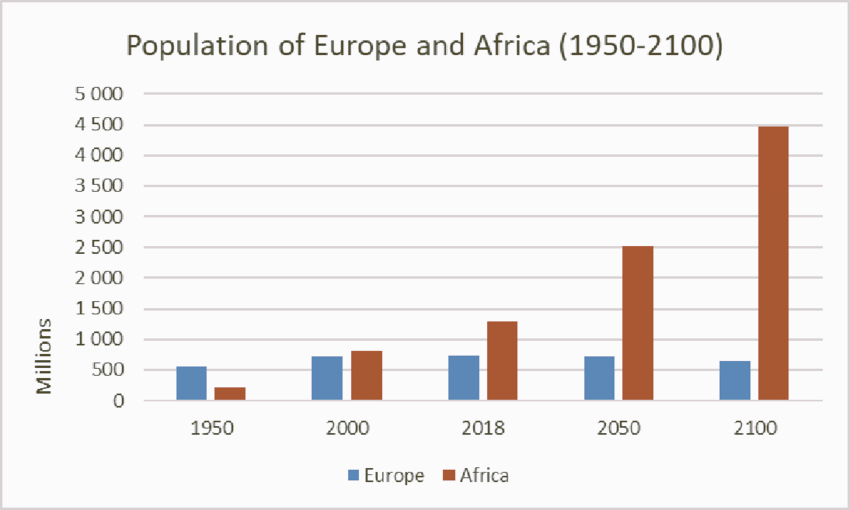
Africa will have the youngest population in 2050 – and therefore consumption and work will take place on this continent. We are facing massive upheavals not only in terms of the climate, but also in terms of the future of the world’s population, the future of work distribution, which people in Europe need to take into account now. We should avoid that in 30 years’ time the old saga repeats again that nobody saw this coming. The run by European politicians for green hydrogen from Africa shows where the journey is heading. The economic stagnation of many African countries is now becoming an advantage when it comes to renewable energies.
For this reason alone, Africa is important. And also South Africa, which is still a major player in African politics and is often used economically as a gateway to Africa. It should be mentioned in passing that South Africa has taken its share of refugees from Somalia to Zimbabwe. Anyone who looks at the numbers of internally displaced persons in Africa knows how critical the situation is and how few refugees actually arrive in Europe.
We are facing tectonic shifts as humanity, as societies. Europe not really looking beyond their own backyard, thinking only nationally or Eurocentric – even if that is currently “in” – is simply short-sighted and will exacerbate the problems in Europe even more. No one is an island, no one can do it alone: climate, hunger, war, demography in a country and so much more require global solutions.
To break it down and put it simply: we as humanity, as a society, must ensure that wealth, added value, security and future prospects are available in every country (in Africa there are 54 countries covering 30 million square meters). We can only achieve this by working together and with an honesty and willingness to cooperate that can certainly be improved at present. Far-sightedness is required, and solidarity that ultimately also serves those who exercise it. Africa is a continent of the future, and Europe should align its policies accordingly. And NGOs are important points of contact here because they work at a level that enables decision-makers to see and understand realities. They often do very local but crucial groundwork on which society and politics can then build. Supporting NGOs in Africa is far more than charity; it serves the future security and peace of all, especially in Europe.
Filed under: Africa, General, Politics and Society, Reflection, Society and living environment, Uncategorized, Africa, demography, development, politics, refugee, south africa, value added


 God, AIDS, Africa & HOPE