God, AIDS, Africa & HOPE

Reflections / Gedanken

Sick and tired of violence

Iraq, Syria, Sudan, Central African Republic, Ukraine, Yemen, Palestine and Israel – the news of violence, war and terror is a permanent feature on all news channels and I realize fatigue is setting in watching and zipping to all those channels with news seemingly to be for years the same.
Paris, Bamako – lock down in Brussels – and waiting for the next hit – around the world travel warning from the US and the discussions about sacrificing our freedoms fought for over long periods seems to head into a new direction of Orwell’s 1984 and even moreSouth Africa – #feesmustfall of the students means meanwhile arson, violence, destruction – almost hundred attempted murders per day in South Africa, from which are half successful. The taxi mafia continues to rule the streets and create havoc – service delivery protests can’t be without violence and damage anymore and whoever wants to take a drive on the national road N2 between Cape Town and Somerset West must be on the watch out – even police officers are not exempt falling victim of violence.
Coming back to the big world again – happy bombing from France – revenge for Paris, together with Russia and David Cameron can’t wait to extend his military reach in the Middle East – together with the continues and relentless extra-legal killings via drones – another permanent of this year’s news – especially when collateral damage means that unfortunately innocent people are killed too.
And as this would not be enough blood shed the state sponsored killings in the USA and Saudi-Arabia, but also not to forget in Indonesia and in other places seems to pick up again – another example that the capacity of governments and people to exercise respect for the sanctity of life degrades in the moment.

I must admit that I am in the moment sick and tired of all the violence on so many levels. Trying to get into the spirit of Advent as a Christian even worsens the situation as it becomes painfully clear how much we are away from the hope of Advent as the preparation of welcoming somebody in the world we see as the Prince of Peace and the messenger of unconditional love to all creation.
It seems that the new lonely caller in the wilderness we hear from in the bible changed his name from John the Baptist to Pope Francis amongst some other religious leaders . His travel this week to the war-thorn region of the Central African Republic with all the unknown and the danger would be a sign, that there might be other ways to answer violence and brutality than with weapons and violence.

But would that also be possible with ISIS or Daesh? Is there another way than throwing bombs?

I am convinced that bombings are not the answer, but that there are other strategies more promising to end this evil:
For example to acknowledge that there is a steady stream of unhappy Europeans following the call of ISIS and if we really want to root out such extremism we have to start in the suburbs of Paris, of Brussels, of Hamburg, of all the major cities in the USA. We have indeed to battle for the minds and the hearts of those feeling that they are not part of our society. Secondly let’s stop fulling the war in this region with selling weapons to “rebels” and other those, in the moment seemingly on the right side of history – in Afghanistan and Iraq history has thought us that the right side of history can quickly turn into the wrong one – ask the CIA which actually made Bin-Laden the person he became later on. Or Saddam Hussein, who was bolstered first to fight the revolution in Iran before falling out with the USA. Do we never learn out of mistakes?
Bombing, killing, extra-juridical killing by drones – it all creates an environment where people from ISIS will indeed flock together and new terrorists and suicide bombers are created on a daily base. The sad story of Israel and Palestine shows how the devils circle of violence never stops until somebody breaks it. And I am convinced to stop ISIS to gain more territory and cutting them off from the oil trade or trade of antiques will dry them out – cut them of the honor to connect them with  religion or Islam by getting the Umma to simply distance themselves – I am quite sure it will help to make this self-proclaimed caliphate a footnote of history in short time.

And let’s recognize and acknowledge that the wealth of Europe has its base in the exploitation of the African continent and the European colonies worldwide – and that they owe the people in Africa, in South America and where ever all the empires stretched for longer or shorter periods of time. Lots of country borders have been drawn on paper and without looking at situation. Lots of governments and dictators came into power because – at that time –   they either belonged to the anti-communist quarters or the other way around. We still haven’t worked it through – and we still are tempted to continue to make the same mistakes again and again. European governments judge not fairly but whatever suits best the Western World – they don’t have the focus on uplifting the people worldwide but what gives them more profit and fosters the lifestyle, Europe and North America wants to keep as long as possible. Let’s be honest: the conviction that we have to develop a new world order, a new way of dealing with each other is still in the infancy of the conscience of human civilization. We have conquered the technology but the rest lacks behind.

Advent – new beginning – may the feeling of being sick and tired of violence turn into a new approach of making the world a more peaceful place on all levels of life – a life to be called to live to the fullest.

Filed under: Africa, General, Politics and Society, Reflection, Religion and Ethics, Society and living environment, Uncategorized, , , , , , , , , , , , , , , , , , , , , , , , , , , , , , , ,

I am not praying for Paris?

Another day of terror and bloodshed, another day splitting opinions about how to react besides mourning the death. Reading the statements of local academic Professor Farid Esack I actually have to hold my breath. He writes in a Facebook post: “I am not praying for Paris; I am not condemning anyone. Why the hell should I? I had nothing to do with it,” and continues “I am sickened by the perpetual expectations to condemn. I walk away from your shitty racist and Islamophobic expectations that whenever your chickens come home to roost then I must feign horror.”

I honestly don’t think this is the way to comment on a tragedy killing innocent people – it is an insult to those suffered the loss of a loved one, but on the other hand it shows a pattern clearly visible in a lot of statements and talks about acts of terror, about the rise of ISIS and the Muslim faith: A toxic mix of emotions and perceived facts, intermingled in a way not helpful at all to see through the factual side of what happens in the moment. This mix, felt by most bystanders and those having lost loved ones is played with quite heavily by those in power, by politicians and fundamentalists and those trying to create havoc and push their own agenda and ideology without counting the losses.

So how to untangle this mix?

Firstly – and this is directly addressed to Prof Farid Esack: I am sickened if you don’t condemn barbaric acts of terror – you don’t have to feign horror – because it is horror. Realize your sensitivity on real or perceived Islamophobic attitudes and acknowledge that as a Muslim Scholar, you have to deal with it. And “it” means you have to deal not only with perceptions but with the question how Islam is connected to violence in our days and how those developing and studying the doctrine and the teaching of Islam define the relationship between violence, statehood and faith. There are dozens of open questions and you can’t hide behind politics. You are part of the Ummah which has to distance itself clearly from all forms of violence and acts of terror.

Secondly – yes, there is the level of politics and there the West has to come to the party: With the unlawful war in Iraq we seeded what we now reaping. And if there is a human justice in place, people like Georg Bush, Dick Cheney and Donald Rumsfeld initiating not only war but terror, torture and renditions should face the music in a court of international law together with Tony Blair and others.  We continue to earn money with weapons delivered readily to fuel the war in Syria, we bomb a country to its knees like Libya and then let it run its own destruction – the West is two-faced and ambivalent when it comes to those questions. There is a lot the West, you are accusing has to account for.

Thirdly – again yes, it was the West introducing the word “war” in a very unconventional way – the “war on terror” created by President Georg W Busch is the mother of lots of evil today because it was used by its own creator to justify the unjustifiable giving a blueprint also for those now in charge in the “caliphate”. Pandora’s box was opened with the abuse and waterboarding and orange jumpsuits now famously seen in beheading scenes.

Fourthly – all lives matter and yes, there is in our global village a clear tendency to react more emotional when European lives or US American lives are at risk – and global diaries like Facebook make this suddenly so much more visible. And it feels wrong to many as could be seen by the reactions of so many African voices on social media. I find it remarkable that there is a sense that life is valued differently in our earthly village – and we have to work on it to change this perception.

We are in a mess – we reap what we have allowed to be seeded and we have to get out of it. But this can only happen if we overcome our emotions and start working on a better world. And it means first of all to pray and mourn those innocently slaughtered on a daily base, to keep track on all life lost on a daily base. I don’t expect the narrowness of politics to make an immediate difference but I expect us religious people to lay the grounds for a better world. The world ethos of Hans Kueng describes that there will be no peace on earth if religions don’t get it right and they are coming to a basic understanding.  We have to lead, we have to challenge each other, we have to have a robust debate on our relationship to God, to human mankind, to violence and much more, we have to find common grounds. And it all starts with mourning the death of Paris and Kenya and Nigeria and Syria and all those other hot-spots of terror, be it state sponsored or committed by others.

And let us start agreeing: ISIS has nothing to do with Islam, the word “jihad” cannot be used for terror attacks and “suicide bombers” are not connected to any religious faith whatsoever. Lets eliminate all those verbal connections loud and clearly. lets declare that killing and God does never go together and we have done the first step in the right direction. May the dialogue – urgently needed –  begin after untangling the emotions from the facts. And lets pray together for Paris and include the rest of the world in pain and agony…

Filed under: Africa, General, Politics and Society, Reflection, Religion and Ethics, Society and living environment, , , , , , , , , , , ,

Farewell “Christliches” Abendland (Christian Occident)

Arriving back from Europe with lots of fond memories about the HOPE Gala in Dresden and all the other great events I have had the pleasure to participate or contribute, I can’t help but feel a very deep unease regarding the so-called refugee crisis I have seen first hand and the reaction of my German brothers and sisters. Knowing that we Germans always have been blind on the right eye it is nevertheless appalling to see how many people suddenly shift their emotions and reactions loudly into a corner of anxiety and protection of the so-called German identity. History seems suddenly to be static – as if the present state of affair has always been and will always be the only one possible. Creatio ex nihilo – Germany existed since eternity and is now overrun – historic developments never took place… ?

The idea of Europe was officially founded on values like human dignity and human rights and a decent life for all, but it seems in practice it was all about finances and markets but not about people. While the “Christian roots” of Germany and Europe are mentioned at every demonstration against those fleeing to Europe, practically the value of welcoming the stranger, especially the one searching refuge seemed to be scrapped from the holy book and it’s heritage. There are too many coming, I hear again and again.
And yes, I do agree, there are indeed many coming, but has nobody been able to read the signs prior to the stream of desperate people building up in recent months? Has nobody noted that selling weapons and looking on while a country is completely destroyed in the case of Syria can’t go together for long? Has Germany thought with the Dublin agreement that Lampedusa and all other places in the South of Europe will remain nicely far away from the German way of life? Has nobody noted that cutting the funds for the refugees of the Syrian civil war in Jordan has given them no other chance than either dying in Jordan or trying their luck somewhere else?

It is appalling how especially people in politics carrying the “christian” and “social” label in their party name suddenly seems to have episodes of Alzheimer when it comes to all those hard questions – and there are many more to ask. And no, lets clarify that also: it’s not about being a “Gut-Mensch”, a softy wanting to do always good. It is about the question how ethical it is to have built up wealth by exploiting other countries, earning money on weapons sale, giving Sunday sermons in Parliament and then declaring practically that human dignity only is afforded to those who had the luck to be born in Europe. It’s about an attitude of the rich and mostly white West which touches ground with and is related to the discrimination of black people or South American refugees in the USA. It simply touches on the often outspoken discomfort, African people have when they deal with Europe – somehow related to skin color.
But it obviously also touches on the very basic fact that world politics seemingly dictates the European support for incompetent autocrats or dictators in developing countries as long as they keep quiet about the exploitation taking place or even are complicit to it.

The refugee crisis is a watershed for Germany and for the united Europe – and if they not find adequate and humane answers it will proof again that human mankind has still a long way to go before it recognizes how much it is interlinked, depend on each other and cannot afford to build walls and fences but must invest in the dignity of every human being. Otherwise let’s bid a final farewell to our European Christian roots.


Filed under: Africa, Politics and Society, Reflection, Religion and Ethics, Society and living environment, Uncategorized, , , , , , , , , , ,

Silence or the aftermath of a living legend

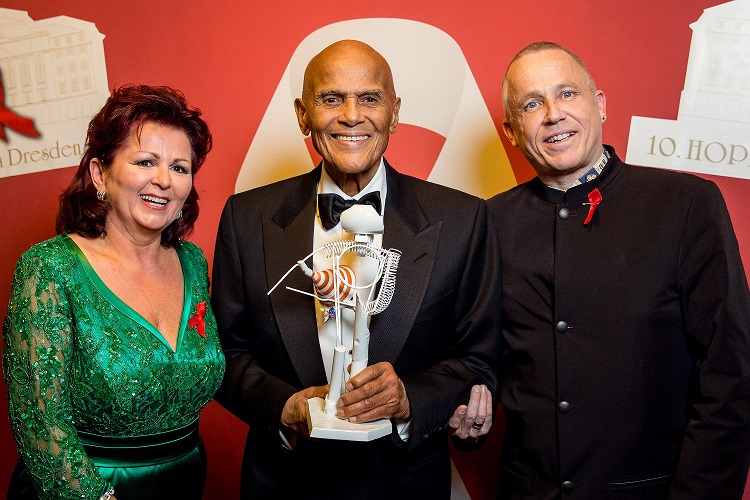
Done – the 10th HOPE Gala in Dresden is part of history and most guests from far have left the city again – others have returned to their daily struggle in so many different ways. There is always that feeling of emptiness after such a big event – memories are formed, thoughts are structured and emails and pictures and newspaper clips remind you on what happened not so long ago.
Silence – I can hear the silence breaking through after days of meetings, encounters, celebrations, dinners, touching moments – and one is again alone with oneself.
But one memory is sticking in my head – another encounter with the living legend Harry Belafonte, “Mr B” as his daughter Gina called him. Charity dinner and HOPE award – and some moments of having a conversation with him. Movie clips recall the first black entertainer appearing on US TV together with a white performer. A friend of Martin Luther King, part of the black movement and the march onto Washington; his fight for civil rights in the USA, his travels and advocacy for Africa and especially South Africa and his friendship with Nelson Mandela – all coming to life in a 10 minute trailer during the charity dinner. But one sentence is still stuck in my mind: “I have never thought that I will campaign and fight for the same things 50 years later again”, he recalls while attending to racial violence in the suburbs of US American cities.
With 88 years, it seems the conclusion is that the fight never stops and that one can do so little only to be change the world or parts of it. But at the same time he is such an inspiration and encouragement while speaking and sharply analyzing the situations of todays world and confirming that he believes in the goodness of humanity.
And he is charming – telling me that “Fr Stefan and Pope Francis” are giving him hope for the Catholic Church and reconciles him a bit as a born Catholic with his church is obviously music in the ears of a priest working in South Africa . But it is also more than flattery after his also long personal struggle with the Catholic Church. And it does not end there: He has the ability to encourage and touch the lives of people instant and with a smile and an aura I have only so far experienced when I met Nelson Mandela. One can feel the struggle, the wisdom and the maturity, but also the goodness of a person without making him an instant saint – he remains human and looking at eye level.Silence – and somehow lots of faces are appearing in my mind – all those people I met during the events in Dresden, all the people who simply gave up time and / or money to come to attend, to support, to give, to share, to participate, to contribute and to make sure that Dresden is heard in this world as a city with heart and soul caring for those infected and affected by HIV and Aids far away in South Africa. For me that is another magic to be touched by the friendliness and commitment of thousands of people in the last 10 years being faithful to one cause – not letting us down but continuing to believe that sharing is making the world a better place. Ubuntu in the best sense of the word.

Silence outside, but inside there are volcanic eruptions of thoughts, of gratefulness, of yearning for a better world, for bridging the gap; there is exhaustion and joy, but also the resolutness to stand up and walk another year in the hope of touching lives and bridging gaps to better the world by assisting those less fortune. And the hope that one day this seemingly endless struggle succeed and the world is a better place for all. Remember these words from the son “We are the world..”? A song Mr B organised to make us all aware of our responsiblity – until today.

I want to conclude this silent reflection with a thanks to Saxonia Systems, Viola and Hermjo Klein, ParX and Michaela Gornickel and her team and all involved in the 10th HOPE Gala in Dresden. You are all in my heart which is grateful forever.Foto Michael Schmidt vl Viola Klein Harry Belafonte Stefan Hippler001

Filed under: Catholic Church, General, HIV and AIDS, HOPE Cape Town Association & Trust, HOPE Cape Town Trust, HOPE Gala Dresden, Reflection, , , , , , ,

Gone with the wind…

When I visit Berlin in these days, one can see school classes standing at points where in previous times a wall had been erected to forcefully separate those in the West from those in the East. A bloody frontier where people lost their lives just for the sake of politics. And if one looks into the faces of those youngsters coming today there you can see blanks as it is almost impossible to imagine the old times or grasp the meaning of separation. It does not make sense anymore at all.
The same way, I think, our church will look back in the future of times like ours, where e.g.communion was used as a tool of punishment or God abused as a policeman bound to human ways of justice. Heads will be shaken reading statements from Cardinals insisting that nothing has to be changed in our church and that the unconditional love of God has to be conditioned by those not believing that the church has changed over time. It seems for those eternal in yesterday living that they not only deny the present to discover God’s love but that they even deny history to be looked at in a truthful way. Slavery was once ok’ed by the church, democracy and human rights damned as the devils tools to bring people down. The idea of freedom of religion came from Satan himself – all those changes seemed to be none existing in the minds of those whose church has never changed. The deepening of discipline, the development of theology, the constant dialogue between other sciences – all gone with the wind and faded away into non-existence when listening to those high up in the hierarchy of the church now defending almost violently orally and in writings  a static church. And what strikes me most: There is no trust in God walking with his church into new green pastures, there is no trust in the Holy Spirit guiding his church as the people of God through times and there is no trust being called like Abraham into the unknown future of existence. And there is a static hierarchy where those above have all knowledge and those called the laity are only called to be observant members of the church.
One could almost feel hopeless but there is always a ray of light somewhere coming. For me it was yesterday the speech of the pope marking the 50th anniversary of the Synod of Bishops. It was a liberating speech – showing that after years, perceived by many as a babylonic time, some important fruits of the II Vatican Council have been brought back into the light.
The Pope in his own words after words of greetings and I know, it is a longer text, but worth reading:
“From the beginning of my ministry as Bishop of Rome I intended to enhance the Synod, which is one of the most precious legacies of the Second Vatican Council. For Blessed Paul VI, the Synod of Bishops was meant to keep alive the image of the Ecumenical Council and to reflect the conciliar spirit and method. The same Pontiff desired that the synodal organism “over time would be greatly improved.” Twenty years later, St. John Paul II would echo those sentiments when he stated that “perhaps this tool can be further improved. Perhaps the collegial pastoral responsibility can find even find a fuller expression in the Synod.” Finally, in 2006, Benedict XVI approved some changes to the Ordo Synodi Episcoporum, especially in light of the provisions of the Code of Canon Law and the Code of Canons of the Eastern Churches, promulgated in meantime. We must continue on this path. The world in which we live and that we are called to love and serve even with its contradictions, demands from the Church the Church the strengthening of synergies in all areas of her mission. And it is precisely on this way of synodality where we find the pathway that God expects from the Church of the third millennium. In a certain sense, what the Lord asks of us is already contained in the word “synod.” Walking together – Laity, Pastors, the Bishop of Rome – is an easy concept to put into words, but not so easy to put into practice. After reiterating that People of God is comprised of all the baptized who are called to “be a spiritual edifice and a holy priesthood,” the Second Vatican Council proclaims that “the whole body of the faithful, anointed as they are by the Holy One, cannot err in matters of belief and manifests this reality in the supernatural sense of faith of the whole people, when ‘from the bishops to the last of the lay faithful’ show their total agreement in matters of faith and morals.”
In the Apostolic Exhortation Evangelii Gaudium I stressed that “the people of God is holy because this anointing makes [the people] infallible “in matters of belief”, adding that “each baptized person, no matter what their function is in the Church and whatever educational level of faith, is an active subject of evangelization and it would be inappropriate to think of a framework of evangelization carried out by qualified actors in which the rest of the faithful People were only recepients of their actions. The sensus fidei prevents rigid separation between “Ecclesia” (Church) and the Church teaching, and learing (Ecclesia docens discens), since even the Flock has an “instinct” to discern the new ways that the Lord is revealing to the Church.
It was this conviction that guided me when I desired that God’s people would be consulted in the preparation of the two-phased synod on the family. Certainly, a consultation like this would never be able to hear the entire sensus fidei (sense of the faith). But how would we ever be able to speak about the family without engaging families, listening to their joys and their hopes, their sorrows and their anguish? Through the answers to the two questionnaires sent to the particular Churches, we had the opportunity to at least hear some of the people on those issues that closely affect them and about which they have much to say.
A synodal church is a listening church, knowing that listening “is more than feeling.” It is a mutual listening in which everyone has something to learn. Faithful people, the College of Bishops, the Bishop of Rome: we are one in listening to others; and all are listening to the Holy Spirit, the “Spirit of truth” (Jn 14:17), to know what the Spirit “is saying to the Churches” (Rev 2:7).
The Synod of Bishops is the convergence point of this dynamic of listening conducted at all levels of church life. The synodal process starts by listening to the people, who “even participate in the prophetic office of Christ”, according to a principle dear to the Church of the first millennium: “Quod omnes tangit ab omnibus tractari debet” [what concerns all needs to be debated by all]. The path of the Synod continues by listening to the pastors. Through the Synod Fathers, the bishops act as true stewards, interpreters and witnesses of the faith of the whole Church, who must be able to carefully distinguish from that which flows from frequently changing public opinion.
On the eve of the Synod of last year I stated: “First of all, let us ask the Holy Spirit for the gift of listeining for the Synod Fathers, so that with the Spirit, we might be able to hear the cry of the people and listen to the people until we breathe the will to which God calls us.”
Finally, the synodal process culminates in listening to the Bishop of Rome, who is called upon to pronounce as “pastor and teacher of all Christians,” not based on his personal convictions but as a supreme witness of “totius fides Ecclesiae” (the whole faith of the Church), of the guarantor of obedience and the conformity of the Church to the will of God, to the Gospel of Christ and to the Tradition of the Church. The fact that the Synod always act, cum Petro et sub Petro – therefore not only cum Petro, but also sub Petro – this is not a restriction of freedom, but a guarantee of unity. In fact the Pope, by the will of the Lord, is “the perpetual and visible source and foundation of the unity both of the bishops as much as of the multitude of the faithful.” To this is connected the concept of “ierarchica communio” (hierarchical communio) used by Vatican II: the Bishops being united with the Bishop of Rome by the bond of episcopal communion (cum Petro) and at the same time hierarchically subjected to him as head of the college (sub Petro). As a constitutive dimension of the Church, synodality gives us the more appropriate interpretive framework to understand the hierarchical ministry. If we understand as St. John Chrysostom did, that “church and synod are synonymous,” since the Church means nothing other than the common journey of the Flock of God along the paths of history towards the encounter of Christ Lord, then we understand that within the Church, no one can be raised up higher than the others. On the contrary, in the Church, it is necessary that each person be “lowered ” in order to serve his or her brothers and sisters along the way. Jesus founded the Church by placing at its head the Apostolic College, in which the apostle Peter is the “rock” (cfr. Mt 16:18), the one who will confirm his brothers in the faith (cfr. Lk 22: 32). But in this church, as in an inverted pyramid, the summit is located below the base. For those who exercise this authority are called “ministers” because, according to the original meaning of the word, they are the least of all. It is in serving the people of God that each Bishop becomes for that portion of the flock entrusted to him, vicarius Christi, (vicar of that Jesus who at the Last Supper stooped to wash the feet of the Apostles (cfr. Jn 13: 1-15 ). And in a similar manner, the Successor of Peter is none other than the servus servorum Dei (Servant of the servants of God). Let us never forget this! For the disciples of Jesus, yesterday, today and always, the only authority is the authority of the service, the only power is the power of the cross, in the words of the Master: “You know that the rulers of the nations lord it over them, and their leaders oppress them. It shall not be so among you: but whoever wants to become great among you must be your servant, and whoever wishes to be first among you must be your slave” (Mt 20:25-27). “It shall not be so among you:” in this expression we touch the heart of the mystery of the Church and receive the necessary light to understand hierarchical service. In a Synodal Church, the Synod of Bishops is only the most obvious manifestation of a dynamism of communion that inspires all ecclesial decisions. The first level of exercize of synodality is realized in the particolar (local) Churches. After having recalled the noble institution of the diocesan Synod, in which priests and laity are called to collaborate with the Bishop for the good of the whole ecclesial community, the Code of Canon Law devotes ample space to those that are usually called “bodies of communion” in the local Church: the Council of Priests, the College of Consultors, the Chapter of Canons and the Pastoral Council. Only to the extent that these organizations are connected with those on the ground, and begin with the people and their everyday problems, can a Synodal Church begin to take shape: even when they may proceed with fatigue, they must be understood as occasions of listening and sharing.
The second level is that of Ecclesiastical Provinces and Regions, of Particular (local Councils) and in a special way, Episcopal Conferences. We must reflect on realizing even more through these bodies – the intermediary aspects of collegiality – perhaps perhaps by integrating and updating some aspects of early church order. The hope of the Council that such bodies would help increase the spirit of episcopal collegiality has not yet been fully realized. As I have said, “In a Church Synod it is not appropriate for the Pope to replace the local Episcopates in the discernment of all the problems that lie ahead in their territories. In this sense, I feel the need to proceed in a healthy “decentralization.”
The last level is that of the universal Church. Here the Synod of Bishops, representing the Catholic episcopate, becomes an expression of episcopal collegiality inside a church that is synodal. It manifests the affective collegiality, which may well become in some circumstances “effective,” joining the Bishops among themselves and with the Pope in the solicitude for the People God.
The commitment to build a Synodal Church to which all are called – each with his or her role entrusted to them by the Lord is loaded with ecumenical impications. For this reason, talking recently to a delegation of the Patriarchate of Constantinople, I reiterated the conviction that “careful consideration of how to articulate in the Church’s life the principle of collegiality and the service of the one who presides offers a significant contribution to the progress of relations between our Churches.”
I am convinced that in a synodal Church, the exercise of the Petrine primacy will receive greater light. The Pope is not, by himself, above the Church; but inside it as one baptized among the baptized, and within the College of Bishops as Bishop among Bishops; as one called at the same time as Successor of Peter – to lead the Church of Rome which presides in charity over all the Churches. While I reiterate the need and urgency to think of ” a conversion of the papacy,” I gladly repeat the words of my predecessor Pope John Paul II: “As Bishop of Rome I know well […] that the full and visible communion of all the communities in which, by virtue of God’s faithfulness, his Spirit dwells, is the ardent desire of Christ. I am convinced that you have in this regard a special responsibility, above all in acknowledging the ecumenical aspirations of the majority of the Christian Communities and in heeding the request made of me to find a form of exercise of the primacy which, while in no way renouncing what is essential to its mission, is nonetheless open to a new situation.” Our gaze extends also to humanity. A synodal church is like a banner lifted up among the nations (cfr. Is 11:12) in a world that even though invites participation, solidarity and transparency in public administration – often hands over the destiny of entire populations into the greedy hands of restricted groups of the powerful. As a Church that “walks together” with men and women, sharing the hardships of history, let us cultivate the dream that the rediscovery of the inviolable dignity of peoples and the exercize of authority, even now will be able to help civil society to be founded on justice and fraternity, generating a more beautiful and worthy world for mankind and for the generations that will come after us.”

(Translation by Fr. Thomas Rosica, CSB, English language media attaché, Holy See Press Office)

Filed under: Catholic Church, Networking, Reflection, Religion and Ethics, Uncategorized, , , , , , , , , ,

Blog Categories

Follow God, AIDS, Africa & HOPE on WordPress.com

You can share this blog in many ways..

Bookmark and Share

Enter your email address to follow this blog and receive notifications of new posts by email.

Join 2,711 other subscribers

Translation – Deutsch? Française? Espanol? …

The translation button is located on each single blog page, Copy the text, click the button and paste it for instant translation:
Website Translation Widget

or for the translation of the front page:

* Click for Translation

Copyright

© Rev Fr Stefan Hippler and HIV, AIDS and HOPE.
Unauthorized use and/or duplication of this material without express and written permission from this blog’s author and/or owner is strictly prohibited. Excerpts and links may be used, provided that full and clear credit is given to Rev Fr Stefan Hippler and HIV, AIDS and HOPE with appropriate and specific direction to the original content.

This not withstanding the following applies:
Creative Commons License
This work is licensed under a Creative Commons Attribution-ShareAlike 3.0 Unported License.