God, AIDS, Africa & HOPE

Reflections / Gedanken

Day 2: 18th April 2011

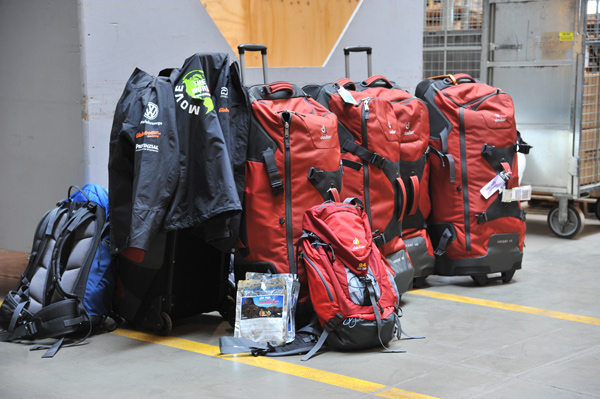
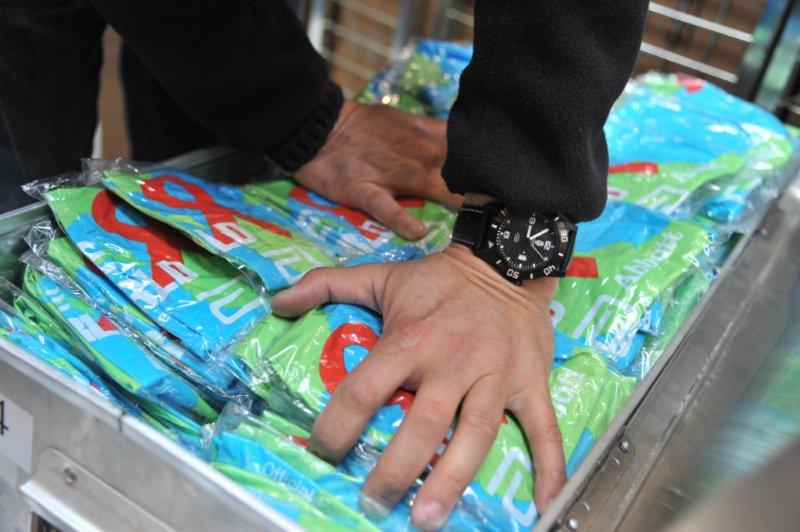
The first working day: early in the morning we went to the centre of distribution to organise ourselves and the five Amaroks, standing there in a row waiting for the big tour to start. But first we have to pack everything into the back of the cars: food, kitchen stuff, water, tools, spare parts, advertising material and all our personal belongings from clothes to a sleeping bag for everybody. We manage to get every Amarok filled to the roof, but there is still some space left for driver and co-pilot.

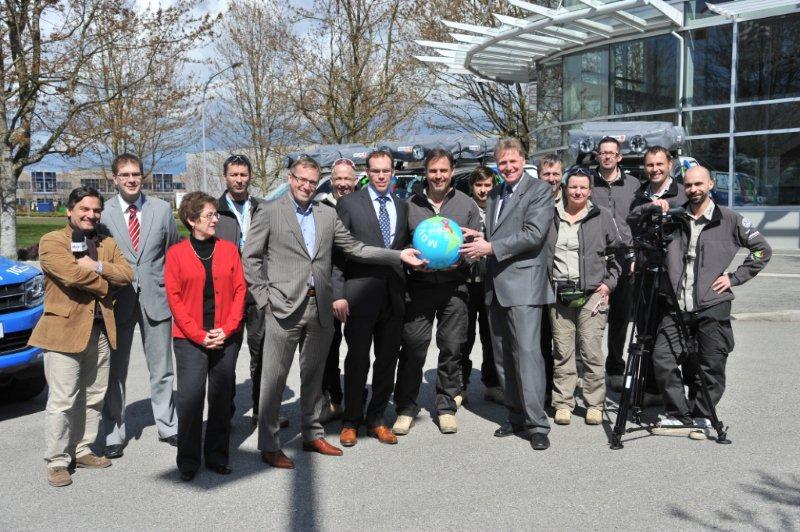
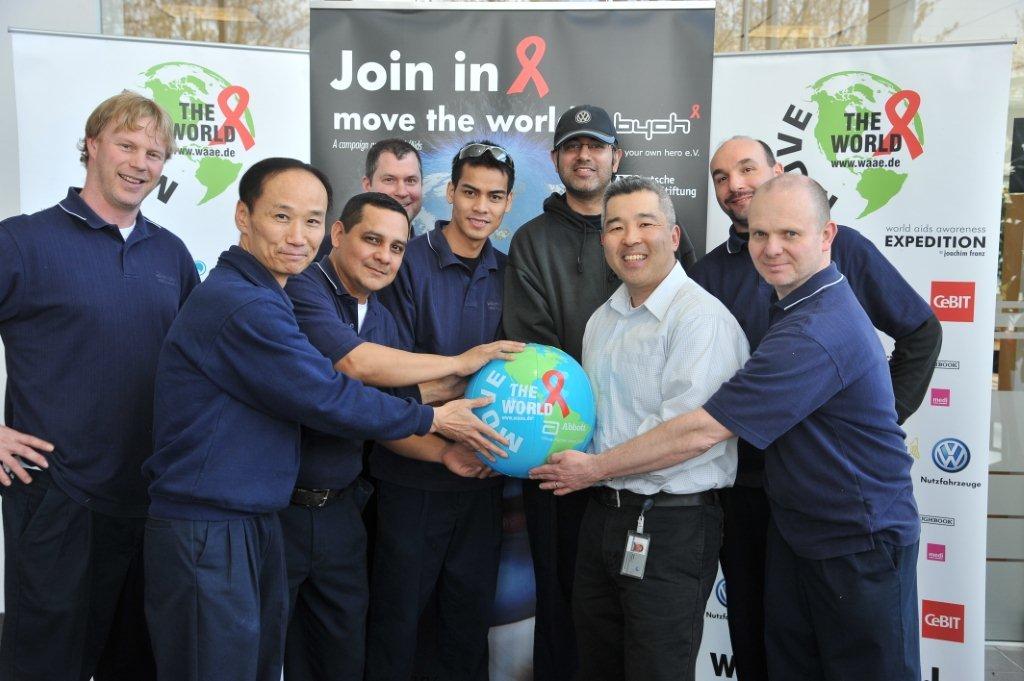
At 2pm the first official meeting. Mark Warsaba, VW manager for the West of Canada, the German Consul General Hermann Sitz, the representative of the IHK Sascha Bardens and media representatives from Vancouver are present to welcome the team at the VW representation in Vancouver. Also the working force of the distribution centre is present and Joachim Franz explains the expedition and the motives lying behind the awareness tour.

After some interviews we drive back to town, just to experience that taking Diesel is not the usual thing to do in Canada. Petrol station after petrol station offers everything except Diesel. At the same time, the hunt for a suitable petrol station gives us the opportunity to test the cars with a full load.

Finally we head to the popular Stanley Park to do some film and photo shooting – and experience many people taking note of our cars, taking flyers and asking for more information about the expedition.

At the end of the day we head back to the VW distribution centre to park the cars for one more night – tomorrow we will be back early, to leave Vancouver and head towards the USA.

Filed under: Uncategorized, , ,

Day 1: 17th of April 2011

Today is the day: we commence our long way to “move the world“, the AIDS awareness expedition 2011. The starting day is also a day to bid farewell in Wolfsburg and Berlin, in Bad Camberg, Nizza, Cape Town and Norway. For almost four months we will live and work apart from our life partners, children, families and friends, for all of us not an easy decision and a daily challenge.

In Birkenfeld the mayor, Mr. Schebler, bids farewell to Sandra and Uwe from Unterfranken, a part of Bavaria. The parish priest, Rev Fr Possmayer wishes us well, luck and he bestows a blessing on us and the whole team. And last but not least a word of greeting from Rudolf Wukovich, president of “be your own hero e. V.“ concludes the farewell cermoney.

The day continues to be a long one: two hours flight from Frankfurt to London, followed by another 10 hours of flying to Vancouver. With the stop over of two hours we need more than 14 hours to reach our first goal.  Our emotions are a mixture of excitement, melancholy and the feeling of responsibility. We would like to succeed in adding to the fight against HIV and AIDS in a meaningful way.  Not easy to catch some sleep while flying against the time, but most of us are simply lost in different thoughts, interrupted from some dozing away in between.

It is late afternoon when we arrive in Canada, Lothar and Gudio are our welcome team, having been here since Friday to do some preparation for the cars. They are waiting for us at the VW centre of distribution in Canada.

We arrive at our hostel in the middle of the old part of Vancouver; take a bite before falling into bed and hanging on a last thought before dozing away: We have completed the first step in our adventure to “move the world”.

Filed under: Uncategorized, , ,

24 hours to go

Slowly but surely this week comes to an end. A week still filled with the last preparation, especially mental preparation. I try to strive up all the daily routines, I try to avoid all the unnecessary, what has still to be clarified and now concentrate on what is ahead of me. The reading in the plenary room of the Bavarian Parliament lies behind me; this was a challenge in its own right but at the end also a very supportive event. The preparations for the BUGA event in October were done yesterday.

The closer I come to the flight to Vancouver,the more I understand the challenge lying ahead of me and I am aware that I can only succeed if I can let go the routine of my life and see this time ahead also as a chance to discover myself again. It is amazing for me to experience that even in this global village  where everything seems so close by, there is still room for a feeling of exploration and discovery – a feeling of curiosity – a feeling of leaving safe and calm waters to reach for the unknown…

It feels good and scary at the same time to feel that there is indeed in my so predictable world still room for a new departure – meaningful and full of possibilities. And moving the world in the way intended means at the end also moving myself into a new direction – I am thrilled to see what the person looks like, besides all new knowledge about HIV and AIDS in the world, who will appear at the end of the expedition…. “Move the world”, the World AIDS Awareness Expedition will be more than an adventure or a fact finding mission or a fundraising event, it will also be a spiritual journey in its own right.

Filed under: General, Networking, Reflection, Uncategorized, ,

Drug wars, guerrilla fights, terror, revolution and a nuclear catastrophe

Move the world means also making a detour

That is not how we did imagine it: We introduced the theme of our expedition for 2011 „move the world“ – but never imagined that people take this literally in many parts of the world.
The constant flow of new crisis areas is forcing us to reorganise the route of our tour. The imaginary „W“-route  (standing for world) which we wanted to follow received some cracks, but that is life We want to safe lives by doing our awareness expedition, but not put at risk unnecessary our lives.

In the moment we are really sometimes don’t know where to start with reorganisation. And it affects not only Arabic countries. One example is Mexico: A travel warning was issued while there is an ongoing drug war. Or Colombia: When we started planning, it was an easy job. But now it seems FARC and drug cartels restarting their fight against the government. In Ecuador we will arrive on the day of a referendum regarding the new constitution – unrest and violence is expected and there is a ban on gatherings.  So how about gathering for a „Round Table“?
Regarding the Americas we have no chance but to get through, partly with the assistance of police and military.

And have a look to the top of Africa. We had to skip Tunisia and Algeria for the danger of being abducted during route through the West-Saharan countries. We now go via Mauritania, Mali, Burkina Faso and Nigeria knowing of the risk of Al Quaida and various militias. How the situation is in Sudan and Egypt when we arrive there nobody knows. Add Jordanian and Syria – lots of open question marks in the moment.

Well, last but not least the disaster in Japan. We were aimed to go from Vladivostok to South Korea and then continue flying to Australia. In the moment it will only remain a plan. Experts speak about the risk of more radiation in the area – so there is the only solution to plan and to hope for the best.

So at the end we will go with plan A, plan B and sometimes plan C in the pocket – what this means for the logistics you can only imagine. New visa applications and the organisation of new „Round Tables“are keeping us busy

At the end, we pan and will see how it works out – a sort of excitement we don’t really need seeing all the usual commotions planning such a tour.

Why take we on this challenge?
The answer is simple: We know that moving the world is a huge task and we can’t run away when the first difficulties arise. 1.8 million people have died as the consequence of HIV and AIDS in 2009, 14 millions kids have no parents in Southern Africa due to the pandemic. 33 million people carry the HI virus. That is simply not acceptable. So we will return to the drawing tables as many times as we have to do to change the route, always having our aim in front of our eyes.

We keep you informed…

Filed under: Uncategorized, , ,

UNAIDS Press Release regarding the Milleniumgoals

In lead-up to June High Level Meeting, progress report presents overview of efforts needed to help countries achieve universal access to HIV services and zero new HIV infections, discrimination and AIDS-related deaths.

NAIROBI, 31 March 2011—Thirty years into the AIDS epidemic, investments in the AIDS response are yielding results, according to a new report released today by United Nations Secretary-General Ban Ki-moon. Titled Uniting for universal access: towards zero new HIV infections, zero discrimination and zero AIDS-related deaths, the report highlights that the global rate of new HIV infections is declining, treatment access is expanding and the world has made significant strides in reducing HIV transmission from mother to child. Between 2001 and 2009, the rate of new HIV infections in 33 countries—including 22 in sub-Saharan Africa—fell by at least 25%. By the end of 2010, more than 6 million people were on antiretroviral treatment in low- and middle-income countries. And for the first time, in 2009, global coverage of services to prevent mother-to-child transmission of HIV exceeded 50%. But despite the recent achievements, the report underscores that the gains are fragile. For every person who starts antiretroviral treatment, two people become newly infected with HIV. Every day 7 000 people are newly infected, including 1 000 children. Weak national infrastructures, financing shortfalls and discrimination against vulnerable populations are among the factors that continue to impede access to HIV prevention, treatment, care and support services. The Secretary-General’s report, based on data submitted by 182 countries, provides five key recommendations that will be reviewed by global leaders at a UN General Assembly High Level Meeting on AIDS, 8–10 June 2011.

“World leaders have a unique opportunity at this critical moment to evaluate achievements and gaps in the global AIDS response,” said Secretary-General Ban Ki-moon at the press briefing in the Kenyan capital. “We must take bold decisions that will dramatically transform the AIDS response and help us move towards an HIV-free generation.” “Thirty years into the epidemic, it is imperative for us to re-energise the response today for success in the years ahead,” said UNAIDS Executive Director Michel Sidibé, who joined Mr Ban for the launch of the report. “Gains in HIV prevention and antiretroviral treatment are significant, but we need to do more to stop people from becoming infected—an HIV prevention revolution is needed now more than ever.”

Rebecca Auma Awiti, a mother living with HIV and field coordinator with the non-governmental organization Women Fighting AIDS in Kenya told her story at the press conference. “Thanks to the universal access movement, my three children were born HIV-free and I am able to see them grow up because of treatment access,” she said.

In the report there are five recommendations made by the UN Secretary-General to strengthen the AIDS response:

  • Harness the energy of young people for an HIV prevention revolution;
  • Revitalize the push towards achieving universal access to HIV prevention, treatment, care and support by 2015;
  • Work with countries to make HIV programmes more cost effective, efficient and sustainable;
  • Promote the health, human rights and dignity of women and girls; and
  • Ensure mutual accountability in the AIDS response to translate commitments into action.

The Secretary-General calls upon all stakeholders to support the recommendations in the report and use them to work towards realizing six global targets:

  • Reduce by 50% the sexual transmission of HIV—including among key populations, such as young people, men who have sex with men, in the context of sex work; and prevent all new HIV infections as a result of injecting drug use;
  • Eliminate HIV transmission from mother to child;
  • Reduce by 50% tuberculosis deaths in people living with HIV;
  • Ensure HIV treatment for 13 million people;
  • Reduce by 50% the number of countries with HIV-related restrictions on entry, stay and residence; and
  • Ensure equal access to education for children orphaned and made vulnerable by AIDS.

As international funding for HIV assistance declined for the first time in 2009, the report encourages countries to prioritize funding for HIV programmes, including low- and middle-income countries that have the ability to cover their own HIV-related costs. It also stresses the importance of shared responsibility and accountability to ensure the AIDS response has sufficient resources for the coming years.

The report and more information about the High Level Meeting on AIDS can be found online at: unaids.org/en/aboutunaids/unitednationsdeclarationsandgoals/2011highlevelmeetingonaids/


Filed under: HIV and AIDS, HIV Prevention, HIV Treatment, Medical and Research, Politics and Society, , , , , ,

Blog Categories

Follow God, AIDS, Africa & HOPE on WordPress.com

You can share this blog in many ways..

Bookmark and Share

Enter your email address to follow this blog and receive notifications of new posts by email.

Join 2,711 other subscribers

Translation – Deutsch? Française? Espanol? …

The translation button is located on each single blog page, Copy the text, click the button and paste it for instant translation:
Website Translation Widget

or for the translation of the front page:

* Click for Translation

Copyright

© Rev Fr Stefan Hippler and HIV, AIDS and HOPE.
Unauthorized use and/or duplication of this material without express and written permission from this blog’s author and/or owner is strictly prohibited. Excerpts and links may be used, provided that full and clear credit is given to Rev Fr Stefan Hippler and HIV, AIDS and HOPE with appropriate and specific direction to the original content.

This not withstanding the following applies:
Creative Commons License
This work is licensed under a Creative Commons Attribution-ShareAlike 3.0 Unported License.