God, AIDS, Africa & HOPE

Reflections / Gedanken

Easter means hope

It was amazing to see how many people cheered President Ramaphosa after his last speech where he prolonged the lockdown for South Africa another 2 weeks till the end of April. It seems that the fear of people overwrites all common sense; the question whether lives to be rescued or economy was in the aftermath highlighted as the all decisive question. And obviously for most people the answer was clear cut out: Ramaphosa was choosing life above economical matters.
I don’t share this clear cut assessment: It is not about life or economy – it is about how people survive in a decent and human way after the crisis is fading away. There is no escape from the virus and let’s be honest: the daily figures are relative in South Africa – we test too little and our statistics are at best an indication of direction, the virus takes us. Killing the livelihood of people while battling the virus does not fulfil the aim of the current strategy. The virus will linger on – there is no final defeat and this should be clearly communicated. This virus will live with us and as with all those small little creatures, we have to live and constantly battle it. It’s part of evolution – and we are part of evolution. Human mankind is not the master of evolution.

There must be a balance in a country which suffers already from high unemployment, corruption, failed economical strategies, poverty and a clear disconnect between those ruling and those being ruled. The despair of people in the townships, their inability to keep distance because of population density, the time wise heavy-handed enforcement efforts by police and military speaks volume about all the question marks currently entertained by worried citizens.
It is indeed clear that the virus demands caution, physical distancing, covering mouth and nose and other behavioural adjustments. But with all this must go a realistic hope and a sustained way to keep society economically viable and alive. People must see an exit strategy of a lockdown which is quite unique with its stringent measures here in South Africa. Being told what is essential or not to buy, being – depending on how your living conditions are – deprived of exercise and fresh air, walking your dog, smoking a cigarette (because you are out of stock at home) and all the rest can go only as far as people are willing – out of fear or conviction – to adhere to.
In Europe there are first data showing that people start to question restrictions and politically there is clear talk about how to have an exit strategy for a new reality after Covid-19. An exit strategy means hope – and hope is needed in times of despair. The feast of Easter encourages hope, it tells of a light at the end of the tunnel, it talks about life giving and life saving stories billions of people have used since this man from Nazareth lived and died to keep the flame of hope alive in personal life, but also within the fabric of societies.

Hope always speaks of courage – a courage born out of the promise that life has a meaning and that every life is important and can contribute to the well-being of this world. This hope of Easter overcomes fear and anxiety and leads to new life, a new reality not only after death, but already here and now. This hope must therefore also have consequences how we deal with this crisis.

May this easterly hope guide us through this challenging time and support a way bringing balanced solutions on our way into a so-called new reality after Corona.

Filed under: Africa, Politics and Society, Reflection, Religion and Ethics, Society and living environment, South Africa, Uncategorized, , , , , , , , , , , , , ,

Flatten the curve?

“Flatten the curve” is the slogan to be heard all over the world – and South Africa was following the stringent measurements which keeps society at bay in so many countries. But instead of balanced measurements South Africa opted for the more Chinese approach clamping down as at many movements as possible even prescribing in detail what items could be sold or not when venturing out to go shopping. Police and military was sent out to enforce the lock-down, and they continue to try to stop any unnecessary travel of citizens.
Having a day when death by police brutality wins against the number of death through the Coronavirus certainly tells a story on its own. There are many questions whether physical distancing is working in the high density townships of South Africa, even more whether the ban of cigarettes or fresh air and some exercise really make sense.
But there is another question lingering in the air which is of equivalent or even more important:

Does the “flatten the curve” approach is feasible in a country which just was downgraded to junk status; a country economically falling apart, unemployment on a very high scale, more people on social grants than in work and a national debt exceeding 3 trillion Rand and going up to 4.5 trillion in the next years?
How long can a country, after years of state run corruption and the current constant lingering in no-man’s land of real decision-making in this regard flatten the curve before it is economically and socially broken beyond repair in the lifetime of those anyhow currently struggling?

Virologists tell us that without flattening the curve the death toll would be very high but the virus run out of steam in a couple of weeks while flattening the curve will save thousands of lives and prevent the collapse of the anyhow weakened health system. South Africa has seen in the Aids Pandemic what it means to lose people on a daily base in their hundreds. It can vouch for the tears and pain of an almost lost generation and the ignorance of a government towards its people. This time no one can complain about any ignorance – being prescribed what you can buy is the opposite of ignorance – one almost has the impression, there is never a middle ground in South Africa.

So the question is how to balance all this in a way which makes the most sense? How to take the people with on the journey beating the virus without destroying the future of the country economically?
The Covid-19 pandemic and how to react is a question in the crossroads of economic and ethical questions, it wonders our approach to life and meaning of life. And it certainly makes unmistakable clear that human mankind is not the master of the soil but part of something much bigger, part of the lot which we call the universe.

This is obviously not only a question for South Africa but the world as such. Nevertheless, in a country with its very unique and painful history, its still open wounds of the past and its attempt to walk as a democratic society, the challenge to balance remains.
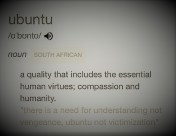
Authoritarian solutions like in China are not adequate nor copies of the sophisticated European systems – we South Africans should have “ubuntu” as the baseline to find our own way to deal with the curve.

Filed under: Africa, Politics and Society, Reflection, Religion and Ethics, Society and living environment, South Africa, Uncategorized, , , , , , , , , , , , ,

Balance is needed and realities appreciated

It is said that in South Africa, it is difficult to find middle ground – it is either black or white, laissez-faire or authoritarian, and looking at measures taken in the country it seems to confirm this observation. Stringent and harsh measures were announced and tried to enforce in the last days leaving behind those whose life reality is so different from those who try to prescribe them. So we saw in many township communities chaos on Friday, the first day of the lock-down: people still had to go to the shops because only when they are paid, they can go shopping. It was clear that government simply forgot to factor in reality.
Videos of aggressive reacting military without any possibility to identify them; police ordering people out of their own yard into their house with doors closed and so demonstrating that they did not understand the rules neither but also township residents defying orders and calling Covid-19 a white man’s disease demonstrated the gaps in dealing with the crisis. On the other hand: it is indeed an overwhelming task to get all citizens to understand the seriousness of this challenge.

Obviously too harsh measures will backfire – and it is noted that e.g. the sale of cigarettes is now allowed in supermarkets – there is no meaning in keeping a smoker 21 days without cigarettes and expect him to feel relaxed at home during lock-down. Government must and should fine-tune measures, but obviously having problematic ministers like Cele running partly the show will make this a challenge for the nation. Especially in a township environment where people really have to struggle every day to survive measures must be coherent, but also understandable and manageable for those living there.
In a situation like ours it would also be good if the President himself is able to reassure the nation on a regular base – people here simply listening rather to him than to compromised ministers or head of departments. State capture has destroyed quite some trust into state organs and this should not be underestimated. It also has widened the gap between those who have or are in charge and those whose life has not changed a lot in the last years still remaining under the poverty line.

There is another aspect which seems important – giving out the figures of confirmed testing does only tell half of the story as we know the virus can come and go without needing hospitalization.  We need antibody tests to find out how many people are already immune and survived the virus without major consequences.  We know that children and younger people are less likely to develop tough symptoms. So knowing the infection rate, but also the immunisation rate can give important indications for the future handling of the pandemic.  It also helps to give people a perspective of what to expect in the next months to come. As important the update of current status is, important is also to give citizens a realistic hope and with that a goal to achieve jointly as society.

Finding a balance after a good start, appreciating realities and work with them – we will see what the next days might bring on fine-tuning measures, transparency in communication and also some more training for SAPS and SANDF so that the service with humility, the president spoke about, becomes a reality. In days like these citizens put their trust in government by allowing the curtailing of civil rights – alone this must be reason of careful consideration how to progress in the fight against Covid-19 in South Africa.

Filed under: Africa, Politics and Society, Reflection, Society and living environment, Uncategorized, , , , , , , ,

Covid-19 warriors

Judging social media it seems that quite a handful of people are sitting in ordered or self-imposed quarantine and favour the social media world with their plights, tribulations and realizations – like warriors in a battle, not shying away from posting all the horror headlines and predictions making their sacrifice of self-containment even more worthwhile. Watching streamed TV from Germany every real and wannabe star feels the urge to post videos with the “I am ok” messages as if the world is really desperately waiting for it.
It reminds me of the many World Aids Conferences, where the only badge to wear and being applauded for is for many speakers to be HIV positive.
I never got it, and I am not sure I get it now.

We know that 60-70% of the population will be infected by the virus and for most of them, it will be like the normal flu or even less, the virus will pass by – especially young people and this might be the blessing for South Africa. A different story are the elderly and those whose immune system is already strong compromised – and here solidarity is needed to protect them. But is this not something what should be normal to do? Without big words and gestures?

As Africans, the principal of ubuntu, the knowledge that there is a dependency which grants life to be lived to the fullest spells already out to have that practical compassion and avoid any situation where the most vulnerable are being brought into the danger zone. Here again, this African spirit of connectivity could be an example for the rest of the world demonstrating values which might have to be gained and learned again in other countries. The implicitness of solidarity and compassion is a gift this continent, which produced the first humans could pass on to the world.

Covid-19 is a chance to get back to our roots of humanity – and the pure fact that normal human behaviour has to be pointed out – or even in Europe more and more enforced –  shows how much the world has lost its moral compass. Covid-19 will come and go – and it is up to us to learn the lessons provided to us – every threat is also a challenge. So let’s pass this test, score all positive points possible and together make the world a better place.


Filed under: Africa, Reflection, Society and living environment, South Africa, Uncategorized, , ,

Blog Categories

Follow God, AIDS, Africa & HOPE on WordPress.com

You can share this blog in many ways..

Bookmark and Share

Enter your email address to follow this blog and receive notifications of new posts by email.

Join 2,711 other subscribers

Translation – Deutsch? Française? Espanol? …

The translation button is located on each single blog page, Copy the text, click the button and paste it for instant translation:
Website Translation Widget

or for the translation of the front page:

* Click for Translation

Copyright

© Rev Fr Stefan Hippler and HIV, AIDS and HOPE.
Unauthorized use and/or duplication of this material without express and written permission from this blog’s author and/or owner is strictly prohibited. Excerpts and links may be used, provided that full and clear credit is given to Rev Fr Stefan Hippler and HIV, AIDS and HOPE with appropriate and specific direction to the original content.

This not withstanding the following applies:
Creative Commons License
This work is licensed under a Creative Commons Attribution-ShareAlike 3.0 Unported License.