


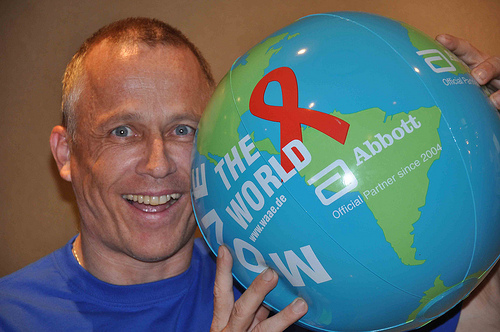


Move the world 🙂
Filed under: HIV and AIDS, HOPE Cape Town Association & Trust, Networking, HOPE Cape Town Association & Trust, Move the world, people living with the virus

03/22/2011 • 3:10 pm Comments Off on Move the world…
02/13/2011 • 8:37 am Comments Off on The knives are out at home…
It seems the knives are out in the Catholic church especially of my country of birth and in Europe – everybody wants dialogue but it seems that every fraction is fighting seemingly assuming that their position is the right way into a bright future of the RC church. The permission of the “old tridentine mass” as the extraordinary mass and the remarks of the pope regarding the condom use in the book of Mr Seewald – mixed with the abuse cases, the attempt to change the text of the mass to make it more “latin like” – from outside it looks frightening – fulled by irresponsible essays and news of so-called “catholic” websites in German language lacking every inch of the ethos of Catholicism and using a language rather be found in the times of the thirties of the last century in Germany. The just published declaration of theologian in Germany calling for a review of celibacy, women ordination and viri probati shows that since the II Vatican Council, nothing really has moved in these fields – binding our energy for matters which should have been resolved a long time ago.
If we really want to tackle the issues of the people and the faithful of our times, we have to stop fighting but first of all listening to each other. What energy is burned to hold up a certain ideology in our church or a so-called “tradition” – anxiety instead of freedom, attack and defence instead of listening to God’s good spirit.
And obviously this has also consequences for the topic, this blog is reflecting about. How much energy some put in to defend “Humanae Vitae” in a way which simply made it impossible within the church to develop an answer to the question: protection of life. And as Benedict XVI dared to speak his theological mind not saying anything new – for days the newspaper were full of comments and the Vatican had to issue three statements to interpret the interview of the pope in the right light. And now Vatican sources tell us that there is a new word on HIV/AIDS to expect, looking at it from a Christian perspective. I hover between hope and despair waiting for this new paper.
I really would like to see a stop on all this navel gazing – how we can serve the people and make their life meaningful, that is the only question we should ask ourselves as members of or church, how we can open ourselves up to God’s spirit without always killing the breeze out of anxiety, stubbornness and a picture of God, which in reality is already outdated when we put it together. Then whoever and where ever God is, I believe that he/she is much more than we ever can think of. And for that, I am indeed grateful.
Serving in the field of HIV/AIDS would mean then to look anew at what sexuality constitutes, what sciences are telling us, how we have developed in the last 100 years. And from there to see how we can create a meaningful and responsible context for sexual activities which also matches the realities of us humans. Seeing how many young people world-wide are still dying we also have to reflect more on what life and death means and how we can learn to speak of a meaningful life, even if it is short. We have to put our view of a “successful” life on the test bench. HIV and AIDS has also to do with evolution, with a virus meeting a new host and being not able to co-exist in a way, other bacteria are living with us since ages. The questions of justice and peace are also still not solved and I am sure the topic HIV and AIDS with all consequences could contribute immensely towards those questions.
So much to do… to reflect … to get down to business …
Filed under: HIV and AIDS, HIV Prevention, Reflection, Society and living environment, Uncategorized, Aids, catholic church, celibacy, Church Matters, hiv, humanae vitae, justice and peace, people living with the virus, theology, women ordination
02/09/2011 • 8:02 pm 2
In the first ruling of its kind in the world, the Geneva Court of Justice has quashed an 18-month prison sentence given to a 34-year-old HIV-positive African migrant who was convicted of HIV exposure by a lower court in December 2008, after accepting expert testimony from Professor Bernard Hirschel – one of the authors of the Swiss Federal Commission for HIV/AIDS consensus statement on the effect of treatment on transmission – that the risk of sexual HIV transmission during unprotected sex on successful treatment is one in 100,000.
The case began in Lausanne in March 2006. The man, originally from the Democratic Republic of the Congo, was convicted of having unprotected sex without disclosing his HIV status to a female complainant. Although the woman was not infected, Article 231 of the Swiss Penal Code allows prosecutions against HIV-positive individuals for having unprotected sex, with or without disclosure. Individuals can also be prosecuted under Article 122, for “an attempt to engender grievous bodily harm”.
The man was also found guilty of several other crimes, including theft, fraud and sexual harassment, and was sentenced to three years in prison. A February 2007 appeal reduced this to 28 months. A second complaint last year led to the man standing trial again, in Geneva in November 2008. According to a report in The Geneva Tribune, an expert medical witness had testified that although treatment greatly reduces the risk of transmission, there remained a residual risk.
Although the man’s lawyer, Nicole Riedle, had entered the statement by the Swiss Federal Commission for HIV/AIDS into evidence, and Geneva’s deputy public prosecutor, Yves Bertossa, had wanted to suspend the hearing in order to consult with the Commission, the lower Geneva court declined to accept any further evidence and he was sentenced to 18 months in prison in December 2008.
Late last month, Mr Bertossa told the Geneva Court of Justice that he was persuaded by the Swiss Federal Commission for HIV/AIDS that the risk of transmission for an HIV-positive individual on successful treatment was less than one in 100,000 and that – under the circumstances – he wanted to drop the charges.
On Monday, the Geneva Court of Justice acquitted the man, who was freed after spending almost three months in prison.
Significantly, it was Geneva’s deputy public prosecutor, Yves Bertossa, who called for the appeal. He told Le Temps that despite the fact that there is still some debate regarding the residual risks of transmission in people on successful treatment this should not influence justice: “One shouldn’t convict people for hypothetical risks,” he said.
Professor Hirschel said that he was very pleased with the outcome. It was, he said, the main reason that he and his colleagues were motivated to issue their January 2008 statement.
Deborah Glejser of Swiss civil society organisation, Groupe SIDA Geneve, said that although the law allows for prosecutions for unprotected sex even when disclosure has taken place, in practice, prosecutions for HIV exposure usually only take place when there is no disclosure, and that a suspended sentence (for a first offence with no aggravating circumstance) is the norm.
Switzerland is made up of 26 cantons, of which Geneva is considered to be the most “liberal”, according to Ms. Glejser. However, since there is no real centralised information about cases, it is not easy to give a comprehensive picture of the pattern of prosecutions and sentences across Switzerland.
She added that Monday’s ruling suggests that, in Switzerland, effectively treated HIV-positive individuals should no longer be prosecuted for having unprotected sex. Having already been contacted by advocates from around the world, she hoped that this ruling will have consequences for other jurisdictions that have HIV exposure laws.
Last May, a five member US Court of Appeals for the Armed Forces panel discussed the effect of treatment on transmission following the appeal of an HIV-positive soldier who had previously pleaded guilty to HIV exposure, following unprotected sex with two women without disclosing his HIV status. Although the majority did not agree, and did not allow the accused soldier’s guilty plea to be set aside, two members of the panel found the medical expert’s testimony – that it was highly unlikely that the soldier could have infected either women because of his low viral load – valid enough to question HIV exposure laws.
And last July, a Canadian court explored the Swiss statement following a submission from Clato Mabior’s defence team that, at the time he had unprotected sex with six women without disclosing his HIV status to them, he did not believe he was infectious. Although expert testimony concluded that Mr Mabior may have been uninfectious for some of the time, this was not enough to convince the judge, who noted that neither the CDC nor WHO/UNAIDS agreed with the Swiss, and that the crimes of which Mr Mabior was accused took place prior to there being any public statement on the effect of treatment on transmission.
Following Monday’s ruling, however, Geneva’s deputy public prosecutor, Yves Bertossa, believes it is only a matter of time before other jurisdictions realise that prosecutions for HIV exposure should not take place when the accused is on successful antiretroviral therapy. He told Radio Lac: “There are some medical advances which can change the law. I think that in other [parts of Switzerland] or in other countries, the same conclusions should apply to their laws.”
Thomas Lyssy from the Swiss AIDS Federation, told aidsmap that they were “very pleased with the judgment of the court. We certainly hope that this precedent will be followed in other Swiss cantons in future cases of a comparable nature.”
References: aidsmap and Edwin J Bernard
Source and full text:
http://www.positivenation.co.uk/news_world/article.php?article_id=159
Filed under: General, HIV and AIDS, Politics and Society, Aids, Geneva, hiv, legal matters, people living with the virus
01/26/2011 • 2:02 pm Comments Off on Interview
Interview with a journalist from the WDR radio – and once again I am reminded how different the situation is in Europe and in Africa. Once again I count all our blessings but also have to list all our challenges: more people on treatment but definitely a growing risk of resistance due to the fact, that medication is not taken as prescribed or discontinued for a while. And yes more people know about the pandemic, but knowing does not mean that they act accordingly. Knowing about HIV does not prevent unprotected sex in many instances, having HIV/AIDS in the curricula of schools or NGO’s or other institutions and companies does not mean that the stigma is going away.
People are still killed or silenced or kicked out when they reveal their infection – people still think it can only be the others but not my partner who is infected. People still go for a test but disappear before the result is revealed. We still have the pre-test counselling which might be a nice way of giving unemployed people a little stipend or allowance, but does it really make sense to scare the willing people off or to have badly trained counsellors – some of them also infected – projecting their fears on the poor client?
“treatment for all ” is still the TAC request – but what would happen to the health system if all are treated? I guess, it would collapse before we achieve the goal; not sure we should accept promises which cannot be fulfilled – and we know it beforehand. Let’s be honest with giving hope rather than creating disappointment.
We have come a long way since Mbeki’s stance of denial, but we still are living in a somehow tribal organized society where the chiefs are having the say – and our chief preaches protection, but handles his own affairs differently.
Somehow during this interview I once again realise how different the realities are on the different continents, and even on one continent, there is a diversity which must lead to different approaches in the same question. What is good for South Africa might not be good for Uganda or Mali.
And this obviously also applies to the handling of matters in my church – no interview without the special questions about church and prevention and my own struggle within this institution. And also here I try to explain that there are no universal solutions fitting to each and very situation – and that the protection of life in all it’s shade must be priority. No ideal, no ideology, even a Christian one, can replace facing the realities of life. Here and now, with the people in front of me, with all their challenges and weaknesses and possibilities I have to work.
Filed under: HIV and AIDS, HIV Prevention, HIV Treatment, Networking, Politics and Society, Reflection, Africa, catholic church, christian, Church Matters, HOPE Cape Town Association & Trust, Mali, people living with the virus, theology, uganda
01/23/2011 • 7:58 am Comments Off on Starting packing…
Normally I start packing earliest a day before I leave the country – but this time is different. The World AIDS Awareness Expedition is only starting mid April but already today I started to collect my stuff and to try to pack it nicely. Space is an issue and this morning I tried out to pack parts of the new cloths I organised for the tour to vacuum pack – interesting, funny, but working. It reduces the space quite a bit.. good so.. Last week I went for all the necessary vaccinations – from hepatitis to yellow fever and cholera – I have it all now and lets hope that it works for me and protect my body from becoming sick. I also decided not to take Malaria prophylaxis – it does not make sense to take it for weeks. But I got a test kit to test immediately if I feel I might be bitten by a mosquito and some emergency medication to keep it at bay. The clock is ticking.. in 3 months we are already 4 days on the run…
Move the world – by watching the blog, which will be hopefully updated during my journey every day – so you can follow and be part of this expedition. And maybe the fundraising effort. We are looking for 5 000 000 people donating each 1 Euro – the money is not for supporting the expedition but projects on the 5 continents dealing with HIV/AIDS like HOPE Cape Town. So if you want to be support, information how to do it is coming soon on this blog.
Be part of a great worldwide experience – and help to move the world…
Filed under: HIV and AIDS, HIV Prevention, HIV Treatment, HOPE Cape Town Association & Trust, Networking, Politics and Society, Society and living environment, HOPE Cape Town Association & Trust, people living with the virus, theology, world aids awareness expedition

The translation button is located on each single blog page, Copy the text, click the button and paste it for instant translation:

or for the translation of the front page:
© Rev Fr Stefan Hippler and HIV, AIDS and HOPE.
Unauthorized use and/or duplication of this material without express and written permission from this blog’s author and/or owner is strictly prohibited. Excerpts and links may be used, provided that full and clear credit is given to Rev Fr Stefan Hippler and HIV, AIDS and HOPE with appropriate and specific direction to the original content.
This not withstanding the following applies:

This work is licensed under a Creative Commons Attribution-ShareAlike 3.0 Unported License.
 God, AIDS, Africa & HOPE