God, AIDS, Africa & HOPE

Reflections / Gedanken

We can’t deny…

We can’t deny that times has changed dramatically, looking at the USA. And those changes are impacting globally not only politics and economy but also the NGO world. The coup from above by wealthy people promoting a clear white fascistoid Christian ideology and voted in by a majority of those who went to cast their vote in the USA is a threat to all, NGOs are standing for in the world.

Ceasing the work of UNAIDS, threatening international courts, leaving what tries to keep countries together in health and human rights, spells also the end of a government by the people for the people. In a world so connected, the “America first” ideology becomes a synonym for a rule determined to ignore all developments in international law, shared values, human rights and human dignity. This is a coup which is not different to those in any African country – only this time not from those suppressed or marginalised. One can only hope that the legal structures of the USA hold tight.

Elon Musk, showing the typical signs of high intelligence and madness at the same time, is more than halfway already in a position through his Starlink to switch on / off the world as he pleases. This creates another danger of note.

Disruptions are good and necessary at times, but when the balance costs lives and threaten entire social contracts without a fair and feasible alternative, it becomes a very dangerous game. The prospect of trade wars, the cutting off of weaker states – with or without the threat of violence – enters then also the realm of NGOs trying often to fill the gaps left by governments. They are part of the social and political fabric of countries. There is a clear line between forging new and enhanced structures serving societies and humanity, or bullying people into submission under political power and wealth without end.

We can’t deny that when times change so dramatically, there are also opportunities. Disruption creates and partly forces new pathways of thinking and action. And this applies in the current situation, specially to Europe and Africa.

The times when we can rely on the USA are gone, and we don’t have to go into detail about China and its politics. The natural partners and neighbours are Europe and Africa. And even if we still have to continue looking into the past, there is the urgent need to look at a joined future. Africa will become a powerhouse of economy and consume in the future, and we have to prepare for it: Europeans have to understand that only importing workers into Europe will not be the solution. Africans have to understand that the role they will have to play means serious soul-searching and the ceasing of asking for hand-outs. The economic sector and NGOs together should drive development on all necessary levels, supported by those in political power.

The current drama holds the opportunity for Europe to revisit with whom it really wants to walk into the future socially and economically on the long term run. It does not mean to abandon relationships with the USA and China, but it means to balance it much more and to realise, that Africa offers 54 countries to partner with. And there are all different in so many ways, as is European countries’ history with them.

Africa has without doubt its own challenges – and there are many. Climate change will add complications to those, and hard and structured work is needed to counter them all. The way forward will not be easy, because it will mean to change the mindset of many on both continents. We have to start working on it now. We owe it to the next generations in Africa and Europe.

Filed under: Africa, Networking, Politics and Society, Reflection, Society and living environment, Uncategorized, , , , , , , , , , , ,

Europe has no future without Africa

Economic refugees, asylum seekers, skilled workers, war refugees: anyone listening to European politicians in debates or on social media today can lose track of realities. Anyone who gets caught in Germany between the fronts of the populist debate with the right-wing party called AfD often completely loses touch with reality and has no chance of really understanding the intricacies of the issue of asylum and immigration. And this will only increase in the course of the German federal elections in 2025 and the campaign to fish on the fringes of the political extreme right.

Another victim of this situation is the view that many people have of Africa and the role that this large continent will and must play in a few decades if Europe wants to have a future. Refugee issues as well as poverty and hunger scenarios on the continent of Africa obscure many facts, for example:

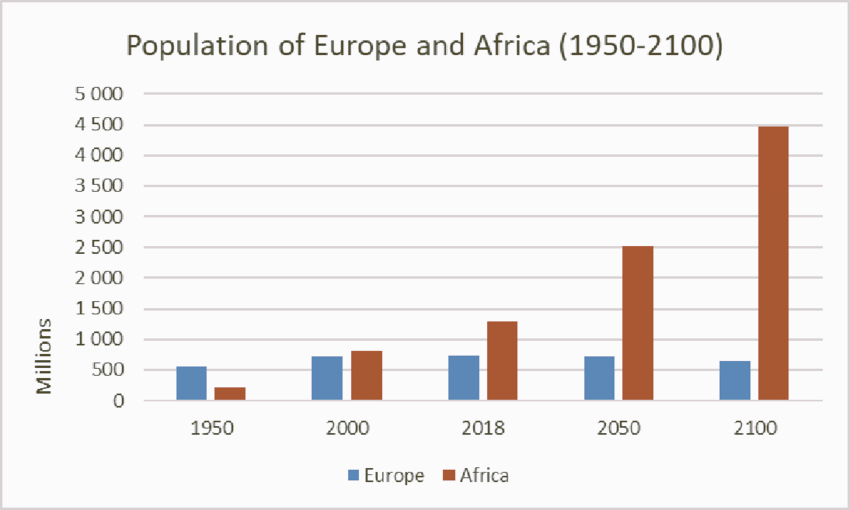
Africa will account for more than half of the world’s young working population in 25 years’ time. Consumption and value creation will take place on this continent.
Africa possesses a large proportion of the mineral resources that are required for the further development of technology.
Particularly in the field of communication technology and renewable energy, Africa is leapfrogging many of the stages in which Europe is still caught up.

But Africa will only be able to play this role if it is prepared. This includes an exchange of information and skills on an equal footing. It also requires Europeans to realise that many environmental and status issues cannot continue in this way, with the corresponding practical consequences. It also includes a real end to colonial thinking and a corresponding development policy.

This also includes an end to the unspeakable refugee policy of European countries, which, instead of genuinely tackling the causes on an equal footing, repeatedly fall back into the old patterns: building walls, pushing refugees onto each other and often ignoring the historical causes and future realities. It is precisely here that the lack of imagination and foresight in politics and the limits of a European spirit of joint political action become very clear.

Of course, Africa and many of the 54 states must also do their homework. This certainly includes the issue of co-operation, but also honesty in looking at their own history and the relations between African countries. Corruption remains an important issue, as does democracy in African culture.

Ultimately, this includes, above all, providing young people in Africa with an education and training that is geared towards this future. Really looking at what the jobs of the future will be. Realising how climate change will change the conditions for human life and work, especially on this continent.

The challenges are complex – and only together will there be a future for the people of both continents. If the ‘America first’ policy in President-elect Trump’s version becomes reality, then it is high time for Europe to wake up and look to its neighbour Africa.

And this is where the many non-governmental organisations come into play. They can become a bridge of communication, learning and engagement at eye level for politics and business. For a good future to become a reality, business and NGOs in particular must give up their normal dance for a little charity and donations and develop joint synergies to enable life, health and a good education on both continents.

The issue is complex and certainly sometimes difficult to communicate to people who have lost confidence in politics. Here too, the NGO level can often assist with the credibility of arguments.

See the original German text under the headline: “Texte in Deutsch

Filed under: Africa, General, HOPE Cape Town Association & Trust, HOPE Cape Town Trust, Networking, Politics and Society, Reflection, SA-German Chamber of Commerce & Industry, Society and living environment, South Africa, The Nex - Indawo Yethu, vocational training, , , , , , , , , , , , , ,

Why should we support an NGO in Africa?

“Why Africa?” is a phrase I often hear when I present the work of HOPE Cape Town. Two weeks ago in Bitburg at the Secondary School I was discussing the question of why young people in Bitburg / a little town in Germany, should be interested in what is happening at the very bottom of the African continent.

“We have our own problems: the war in Ukraine, the many refugees, the economic situation, the climate” – and those, they tell me, “are more important to us than South Africa at the moment.”

The sentiment is right – and Corona and the experience of powerlessness during the pandemic, as well as the government measures that were often perceived as excessive during this time, have massively increased the anxiety and insecurity of many people. Many people’s sense for security has been eroded in times of Covid-19; this has long-term consequences.

But feelings are not always the whole reality – and it seems difficult to understand the complexity of life and interdependencies far beyond borders and distances.

Take the refugee issue in Germany: 2015 was a year Germany felt the influx of refugees in a very special way. But long before 2015, it was clear to anyone who wanted to know that Europe would have a problem that would be massively exacerbated by the climate issue. War, hunger, but also the simple human impulse for more security, prosperity and that children should have a better life are pushing people to flee or embark on the – often supposed – journey to a better future. This has also become a highly attractive business that promises massive profits for human traffickers as well as security companies. And it has become a political pawn between European countries and interests – see Hungary or Turkey, for example – and a bargaining chip for decision-making in the EU and beyond.

People stay at home when it is peaceful and there is a chance to live safely. Nobody sets off on an uncertain journey just for fun or because it’s funny. Sheer economic hardship is also a serious reason for people.

I don’t have the impression that much has really changed on this issue in Germany since 2015. Development policy has not really changed fundamentally. And the political landscape that increasingly consists of professional politicians. They are often distanced from the realities of ordinary people as a result – and their focus is often limited to the next election – they often fail terribly to see the bigger picture, which also includes the far-reaching complexity of matters in our days. Perhaps we also need to think about how politics should be structured differently in such a rapidly changing and evolving world. And whether it should be entrusted to professional politicians; some of whom who never have learned or practised a profession or trade, is another important question.

But back to the question of why people in Bitburg, or let’s say in Germany, should take an interest in what is happening in Africa and do something about it?

The mass exodus of people will not be stopped if money flows through the governments in Africa, which take their “cut” and whose corrupt actions are known and almost factored in.

The problem of refugees will not be solved as long as the economy is mostly seen to benefit Europe and adding value does not take place on the African continent.

Africa will have the youngest population in 2050 – and therefore consumption and work will take place on this continent. We are facing massive upheavals not only in terms of the climate, but also in terms of the future of the world’s population, the future of work distribution, which people in Europe need to take into account now. We should avoid that in 30 years’ time the old saga repeats again that nobody saw this coming. The run by European politicians for green hydrogen from Africa shows where the journey is heading. The economic stagnation of many African countries is now becoming an advantage when it comes to renewable energies.

For this reason alone, Africa is important. And also South Africa, which is still a major player in African politics and is often used economically as a gateway to Africa. It should be mentioned in passing that South Africa has taken its share of refugees from Somalia to Zimbabwe. Anyone who looks at the numbers of internally displaced persons in Africa knows how critical the situation is and how few refugees actually arrive in Europe.

We are facing tectonic shifts as humanity, as societies. Europe not really looking beyond their own backyard, thinking only nationally or Eurocentric  – even if that is currently “in” – is simply short-sighted and will exacerbate the problems in Europe even more. No one is an island, no one can do it alone: climate, hunger, war, demography in a country and so much more require global solutions.

To break it down and put it simply: we as humanity, as a society, must ensure that wealth, added value, security and future prospects are available in every country (in Africa there are 54 countries covering 30 million square meters). We can only achieve this by working together and with an honesty and willingness to cooperate that can certainly be improved at present. Far-sightedness is required, and solidarity that ultimately also serves those who exercise it. Africa is a continent of the future, and Europe should align its policies accordingly. And NGOs are important points of contact here because they work at a level that enables decision-makers to see and understand realities. They often do very local but crucial groundwork on which society and politics can then build. Supporting NGOs in Africa is far more than charity; it serves the future security and peace of all, especially in Europe.

Filed under: Africa, General, Politics and Society, Reflection, Society and living environment, Uncategorized, , , , , , ,

Turn of an era?

We are living in interesting times; we also could say we live in dangerous times or exciting times. However, one defines emotionally current times, it is increasingly becoming clear that humanity faces difficult decisions to make on a variety of questions flocking together in one moment in time.

The Coronavirus has brought us the message, how quick our big and small seemingly stable world can crumble because of a small little virus taking over the world. The way we densify areas to accommodate more people in spaces and the way we extend our habitat into the last pockets of real nature should be reflected on if we as the human species want to have a future on this planet.

Add to this the climate change which becomes increasingly dramatic looking at the so-called eternal ice, the glaciers, the weather patterns which will not go away while elected or authoritarian politicians try to make sense of it – always having in mind that the sacrifices must be on the other site of the fence.

The Ukraine war has shown the people on the “island” Europe the realities of the rest of the word, where violence and war is a much more frequent occurrence. But it also shows how interconnected the world is now and people all around the world are suffering because one leader runs amok for reasons one can analyse, but it does not mean they make sense.

Trump, Johnson, and their likes have brought a culture of lies and fake news to the table. Amplified by social media and as predicted by warning voices, that the amount of information and communication will overwhelm our brains, we have created the best environment to create a fictional reality besides the real reality. And millions, overstrained and anxious, flee into the madness of such fictions. Looking at the USA and its current affairs – the plan of the Christian right together with those wanting to keep the white macho monopoly comes dangerously to conclusion: racism, the upcoming decision “Roe v Wade” has ramifications far beyond the USA. A country and society which is at war with itself and therefore giving rise to others like China, which is posing the biggest threat to human rights, civil rights and civil liberties.

Looking at the overall politics, many democratic systems need an overhaul to arrive in the 21st century, but it is impossible to do with the culture of professional politicians who would never survive in the real world and who have mostly their re-election at heart instead of the people. Our democracies are a shadow of what it meant when the idea was born. It is still often the best we can, but it will not be sufficient to move forward in the next years to come.

And this applies also to international organisations like the UN, being stuck in a post II World War idea and clearly not being able to develop into a tool needed in our times. Alone the fact, that a country, being the aggressor and committing war crimes has a veto power is on all imaginable levels simply wrong.

Social media and democratic structures are also more and more in competition – reading Elon Musk’s announcement that he most likely will unban Donald T from the newly purchased Twitter, looking at the power of a company like Facebook to determine what you are allowed to say or not, the logarithm and AI increasingly and often silently starting to manipulate our lives: we are at a point in time when we collectively need to come to decisions how to proceed as human beings and what values we put first.

There would be so much more to list – the role of religious institutions and their failures, questions of how the global economy is working, questions of the interaction of so-called “developed / developing” countries in relation to the so-called “first world” – whatever that really means when looking at it more in detail.

We need to have more conversations – and when I say conversations I mean really engaging with each other, listening to each other and recreating a culture of engagement. Social Media should assist and stop creating millions of keyboard warriors and bots pushing their point of view in a way which defies the word “communication” and triggers rather aggression and violence.

We need to realise that putting average or professional politicians on pedestals because there are no better ones, or because they have a specific gender, sex or skin colour does not really help but often obfuscate the wanted outcome.

The world of our days offers so many tools and possibilities to reach out and connect; we need to make more out of it, and we have to learn to use it wisely if we really want to come out with a perspective for us humans as part of this world we are living in. We owe it to the next generations that we turn this obvious transition time into something which is worth living.

Filed under: Politics and Society, Reflection, Society and living environment, , , , , , , , , , , , , , , , ,

Still lots of questions…

Insanity is the word I am finding the most appropriate looking at the situation in the Ukraine – especially looking at the history. Helplessness and failure are following on place two and three.

Since Ukraine eight years ago – after a pro-European protest movement toppled a Kremlin-backed president – turned more to the West, the conflict is simmering between NATO and Russia on Ukraine.

We all knew that there was talk after the disintegration of the UDSSR that the western countries will not expand their military alliance towards the Russian borders; even if it was never signed off formally.
I am sure the elderly amongst us still recall the attempt of Russia to install rockets on Cuba in the sixties, and the threat of a nuclear war from then-president J.F.Kennedy, arguing that his country cannot allow such weapons close to the border reaching US territory.

Nothing has changed in this regard – and listening to Angela Merkel back some years stating, that Vladimir Putin lives in his very own world – indicating that this world was far away from any reality.

So my question after rightly condemning the attack with all arguments and emotions – also recalling my visit to Odessa and other Ukrainian cities and worrying about people I met – so my question would be how we can leave the black/white scenario and come to an honest analysis asking the hard questions:

When politics is the art of the possible – was it really necessary to flirt with the NATO membership of Ukraine – which, in fact, was years away?
When politics is the art of the possible – has nobody noticed the brutality with which Zar-like Putin tried to reconvene the “good old times” of a Great Russia – killing every dissent, allowing even for state sponsored murder outside Russia – completely ruthless and without hesitance?

Taking the Crimea was the next step of Putin to announce to the world that he will not allow for the expansion of NATO; and if we are honest, the soft reaction of the West – being dependent on energy from Russia – was rather an encouragement, as in his world, weakness will be used as a sign of reinforcement that he has the upper hand to do, what he feels is appropriate.

Of course, the Trump presidency weakened any hard stance on Russia worldwide – the earlier super-power, now in the grip of fake news and its own battle to remain white male dominant and partly living in a world which is as abstruse and far away from reality as the Russian leader’s one.

And for those really watching closer, the war against Ukraine has another danger for the future: look at China’s reaction: While standing with Russia, China still insists that borders should be respected – but we all know, that the country does not consider Taiwan a country – watch the space. A very unholy alliance is being formed by Russia and China – threatening the very fabric of human rights, civil liberties and the individual freedoms.

So what to do?
Sanctions are threatened and executed – and realising the money flows before the war started, Moscow has prepared itself for quite some time bringing money back into its country. Cutting the SWIFT link would be the sharpest sword, but looking especially at Germany and the Netherlands – it is doubtful that sanctions are called which hurts the own countries. So I guess it will again be those not so much hurting ones – obviously called different by politicians needing to reassure themselves. One has to sound harsh and determined. Too little too late?

So what to do?
Listening to Putin’s indeed on madness bordering speech ordering the invasion, it is clear that common sense will not work and that the limitations of politics as an art of the possible are very tight. As long as the USA flirts with another round of madman Trump and his fascist tendencies, love for fake news and adoration for dictators – like it or not – helplessness will remain the topic of the day.

As long as Europe is still struggling to understand what it really wants and to consequently lives it values and strengthen its determination to be a beacon of hope for democracy and the rule of law, speaking with one voice instead of bitching around and leaders often only trying to push through their countries’ agenda, there is always the gap people like Putin will abuse for own gains and for the own agenda.

While we experience worldwide more and more leaders being relentless and shameless in pushing through their agenda, one can observe on the other site those politicians without really a point of view and determined to be political correct, whatever this means. Most political systems allow meanwhile for people who never have worked, finished a training or study, and they would never survive in the real world, but the chance of being a life-long politician comes to the rescue. A combination which is simply not working on a long term.

A war in Europe – like the pandemic it throws at us a lot of questions, a lot of challenges, a lot of question marks. And as painful it is, we have to stand up to all of it.

A war in Europe – like the pandemic it triggers in us a lot of emotions, a lot of fear and anger, a lot of desperation, and it shows a lot of limitation of what we can do to stop it or deal meaningful with it.

War is always a defeat for humanity, a defeat for politics, and a defeat for the entire human race. It screams for healing and ethical answers.

I don’t have those answers, but all the questions should push all of us to dig deep into ourselves to find the bits and pieces contributing to an answer as societies which holds a meaningful future and limits the craziness of war and hostilities. Because at the end, war and hostilities make us all to be losers.

To read the mind-boggling speech of Vladimir Putin ordering war, please click here.

Filed under: General, Politics and Society, Reflection, Society and living environment, Uncategorized, , , , , , , , , , ,

Blog Categories

Follow God, AIDS, Africa & HOPE on WordPress.com

You can share this blog in many ways..

Bookmark and Share

Enter your email address to follow this blog and receive notifications of new posts by email.

Join 2,711 other subscribers

Translation – Deutsch? Française? Espanol? …

The translation button is located on each single blog page, Copy the text, click the button and paste it for instant translation:
Website Translation Widget

or for the translation of the front page:

* Click for Translation

Copyright

© Rev Fr Stefan Hippler and HIV, AIDS and HOPE.
Unauthorized use and/or duplication of this material without express and written permission from this blog’s author and/or owner is strictly prohibited. Excerpts and links may be used, provided that full and clear credit is given to Rev Fr Stefan Hippler and HIV, AIDS and HOPE with appropriate and specific direction to the original content.

This not withstanding the following applies:
Creative Commons License
This work is licensed under a Creative Commons Attribution-ShareAlike 3.0 Unported License.