God, AIDS, Africa & HOPE

Reflections / Gedanken

Why should we support an NGO in Africa?

“Why Africa?” is a phrase I often hear when I present the work of HOPE Cape Town. Two weeks ago in Bitburg at the Secondary School I was discussing the question of why young people in Bitburg / a little town in Germany, should be interested in what is happening at the very bottom of the African continent.

“We have our own problems: the war in Ukraine, the many refugees, the economic situation, the climate” – and those, they tell me, “are more important to us than South Africa at the moment.”

The sentiment is right – and Corona and the experience of powerlessness during the pandemic, as well as the government measures that were often perceived as excessive during this time, have massively increased the anxiety and insecurity of many people. Many people’s sense for security has been eroded in times of Covid-19; this has long-term consequences.

But feelings are not always the whole reality – and it seems difficult to understand the complexity of life and interdependencies far beyond borders and distances.

Take the refugee issue in Germany: 2015 was a year Germany felt the influx of refugees in a very special way. But long before 2015, it was clear to anyone who wanted to know that Europe would have a problem that would be massively exacerbated by the climate issue. War, hunger, but also the simple human impulse for more security, prosperity and that children should have a better life are pushing people to flee or embark on the – often supposed – journey to a better future. This has also become a highly attractive business that promises massive profits for human traffickers as well as security companies. And it has become a political pawn between European countries and interests – see Hungary or Turkey, for example – and a bargaining chip for decision-making in the EU and beyond.

People stay at home when it is peaceful and there is a chance to live safely. Nobody sets off on an uncertain journey just for fun or because it’s funny. Sheer economic hardship is also a serious reason for people.

I don’t have the impression that much has really changed on this issue in Germany since 2015. Development policy has not really changed fundamentally. And the political landscape that increasingly consists of professional politicians. They are often distanced from the realities of ordinary people as a result – and their focus is often limited to the next election – they often fail terribly to see the bigger picture, which also includes the far-reaching complexity of matters in our days. Perhaps we also need to think about how politics should be structured differently in such a rapidly changing and evolving world. And whether it should be entrusted to professional politicians; some of whom who never have learned or practised a profession or trade, is another important question.

But back to the question of why people in Bitburg, or let’s say in Germany, should take an interest in what is happening in Africa and do something about it?

The mass exodus of people will not be stopped if money flows through the governments in Africa, which take their “cut” and whose corrupt actions are known and almost factored in.

The problem of refugees will not be solved as long as the economy is mostly seen to benefit Europe and adding value does not take place on the African continent.

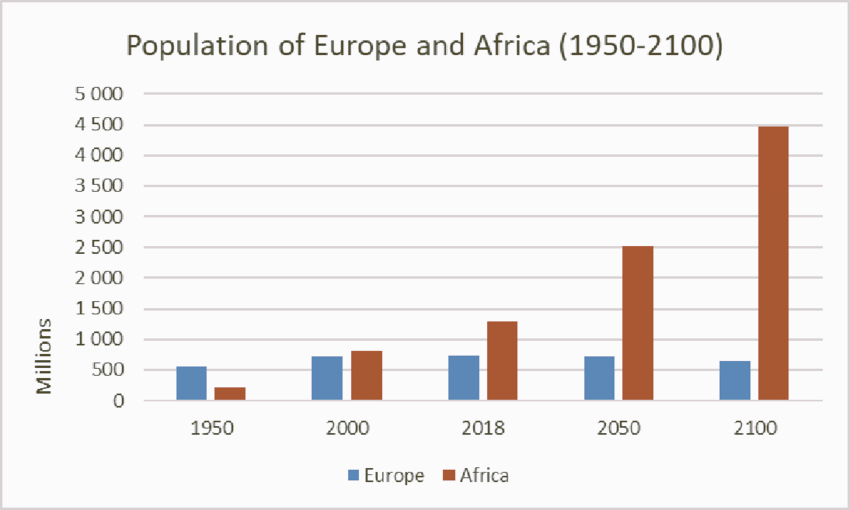
Africa will have the youngest population in 2050 – and therefore consumption and work will take place on this continent. We are facing massive upheavals not only in terms of the climate, but also in terms of the future of the world’s population, the future of work distribution, which people in Europe need to take into account now. We should avoid that in 30 years’ time the old saga repeats again that nobody saw this coming. The run by European politicians for green hydrogen from Africa shows where the journey is heading. The economic stagnation of many African countries is now becoming an advantage when it comes to renewable energies.

For this reason alone, Africa is important. And also South Africa, which is still a major player in African politics and is often used economically as a gateway to Africa. It should be mentioned in passing that South Africa has taken its share of refugees from Somalia to Zimbabwe. Anyone who looks at the numbers of internally displaced persons in Africa knows how critical the situation is and how few refugees actually arrive in Europe.

We are facing tectonic shifts as humanity, as societies. Europe not really looking beyond their own backyard, thinking only nationally or Eurocentric  – even if that is currently “in” – is simply short-sighted and will exacerbate the problems in Europe even more. No one is an island, no one can do it alone: climate, hunger, war, demography in a country and so much more require global solutions.

To break it down and put it simply: we as humanity, as a society, must ensure that wealth, added value, security and future prospects are available in every country (in Africa there are 54 countries covering 30 million square meters). We can only achieve this by working together and with an honesty and willingness to cooperate that can certainly be improved at present. Far-sightedness is required, and solidarity that ultimately also serves those who exercise it. Africa is a continent of the future, and Europe should align its policies accordingly. And NGOs are important points of contact here because they work at a level that enables decision-makers to see and understand realities. They often do very local but crucial groundwork on which society and politics can then build. Supporting NGOs in Africa is far more than charity; it serves the future security and peace of all, especially in Europe.

Filed under: Africa, General, Politics and Society, Reflection, Society and living environment, Uncategorized, , , , , , ,

Handouts and Charity

Working in the NGO field in South Africa, one often meets a sort of demand for handouts and charity to attract people or fill programs with participants. Also, local politicians are tempted to have give-aways at hand – it seems to be the culture of work in the townships of South Africa.

The argument is frequently that people are too poor to pay – or that indeed as mentioned you don’t get people to come if there is nothing for free or to gain. And not even seldom, those invited to join programs ask for what goodies to expect when joining a program. Not to tell about competition within the NGO sector who is able to hand out more.

I get it – indeed, people are poor and times are tough. And yes, it is easier to attract people with food, gifts, and takeaways. But I doubt that this vouches for respect, dignity and development.

Free handouts make people dependent; handouts are charity and needed in absolute emergency situation to stabilize people and to giving them a perspective.

But to change the situation of people, and to foster a non-dependence relationship; to sustain a path to a better life, NGO’s need to walk with people in a giving / contributing relationship. And this does not always have to do with the exchange of lots of money. Small contributions chipped in. Offering talents and time as a contribution. The results:

The acknowledgement of self-worth and the value of what is being offered or jointly worked on. The feeling of being partners on eye-level and respectful towards each other. And the learning curve resulting from all of these aspects: more dignity, more self-respect and the knowledge: I can do it – we can do it together.

All this needs a shift in mindset in all sectors of engagement. It requires the courage to walk the talk of real development; a walk which can be rough and at times scary. But it is the only way to better the lives of people sustainably and to make everybody a real participant and less a dependent waiting for the next handout.

Filed under: Africa, General, HOPE Cape Town Association & Trust, HOPE Cape Town Trust, Networking, Reflection, South Africa, , , , , , , , , ,

Mandela Day reflection

Make everyday a Mandela Day -#itisinyourhands

This was the motto of this year’s Mandel Day.

Mandela Day is an annual global celebration that takes place on 18 July to honour the life and legacy of Nelson Mandela. This day is a call to action for individuals, communities, and organisations to take time to reflect on Mandela’s values and principles and to make a positive impact in their own communities.

I am always amazed to see and read afterwards how NGO’s, politicians and ordinary people are coming together – and even trying to set world records in how much food they have given out and how much soup was distributed.

I see the pictures of smiling kids paraded in front of pots and food and toys …

And I feel uneasy – year after year more – asking myself whether “to reflect on Mandela’s values and principles and to make a positive impact in their own communities” are really translate in hand outs for 67 minutes year after year.

Making a positive impact in a community – is that not more than hand-outs? Does the feel-good-hand-out time with certainly all the good intentions really make a difference in the lives of those who benefit, or is it not a quick pass by of receiving but really not changing the lives of people?

Impact should mean change for the long run – so how can we transform a charity event into a contribution to real development – impact which means real change in the lives of people and communities…

Any suggestions?

Filed under: Africa, Networking, Politics and Society, Reflection, Religion and Ethics, Society and living environment, South Africa, Uncategorized, , , , , , , ,

Human Rights Day in South Africa

The Human Rights Day in South Africa is historically linked with the 21st March 1960 and celebrated as a Public Holiday in the new democratic South Africa.
And why the 21st March 1960, those not living in South Africa, will ask.

Sharpeville is the answer: On that day, 69 people died and 180 were wounded when police fired on a peaceful crowd that had gathered in protest against the unjust pass laws.

Today we commemorate on those events, and those laws are gone, and we live in a free and democratic society, so we say. But looking more closely, we have to admit, that changing to one person one vote has not brought us to the point where human rights are respected in South Africa.

The last weeks we experienced how a political party can call on infringements of human rights and threatened violence with their “national shutdown”. It was in most parts prevented by a coordinated effort of police and security services, as well as court decisions. Alone that Members of the National Parliament are able to use intimidation and threats tells a story.

But looking at the living conditions of many of South Africans, it triggers the question about human rights and the ability to enjoy them in current times.

Human rights are rights inherent to all human beings, regardless of race, sex, nationality, ethnicity, language, religion, or any other status. Human rights include the right to life and liberty, freedom from slavery and torture, freedom of opinion and expression, the right to work and education and the list is longer.

At the end, it is the right to have a decent life in safety and security and sheltered in an adequate human way.

Looking at my working place in a township, I am not sure, I witness human rights making it to the front. Violence, gender-based-violence, poverty, lack of education and work opportunities, just to name some, prevent people from enjoying their human rights. It is not particular one place – many townships and locations don’t provide for the living conditions needed to enjoy the real meaning of human rights and human dignity.

I honestly often take my hat off seeing and experiencing the dignity and good will of people who are deprived of the chances and who still try to make the best out of it.

With all those people of goodwill, there is so much more to do to make our Human Right Day in South Africa a celebratory day. For now, it is a day of reflection and commemoration, but also a day of awareness and a reminder, what all has still to be done.

As the world is currently in general in a bad space or in a transition time, it is even more difficult for an emerging democracy to get it right and to give its citizens what they rightfully are entitled to.

Human Rights Day 2023 – a day of commemoration, reminder, and order and not political Sunday sermons.

Filed under: Africa, General, Politics and Society, Reflection, Society and living environment, South Africa, Uncategorized, , , , , , , , ,

Ball of HOPE 2023

Dear Members, Partners, Supporters and Friends of HOPE Cape Town,

…the countdown has begun!

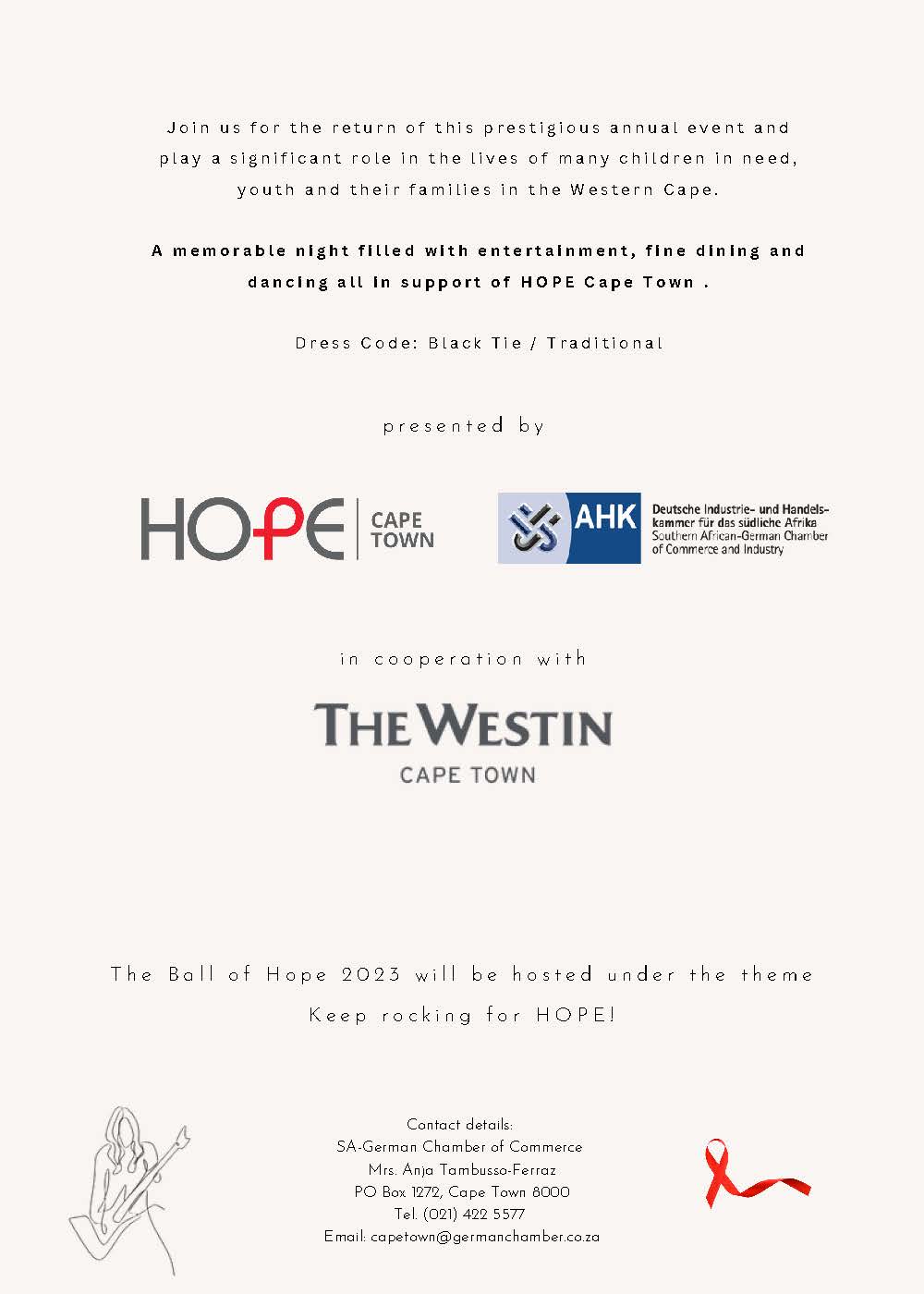
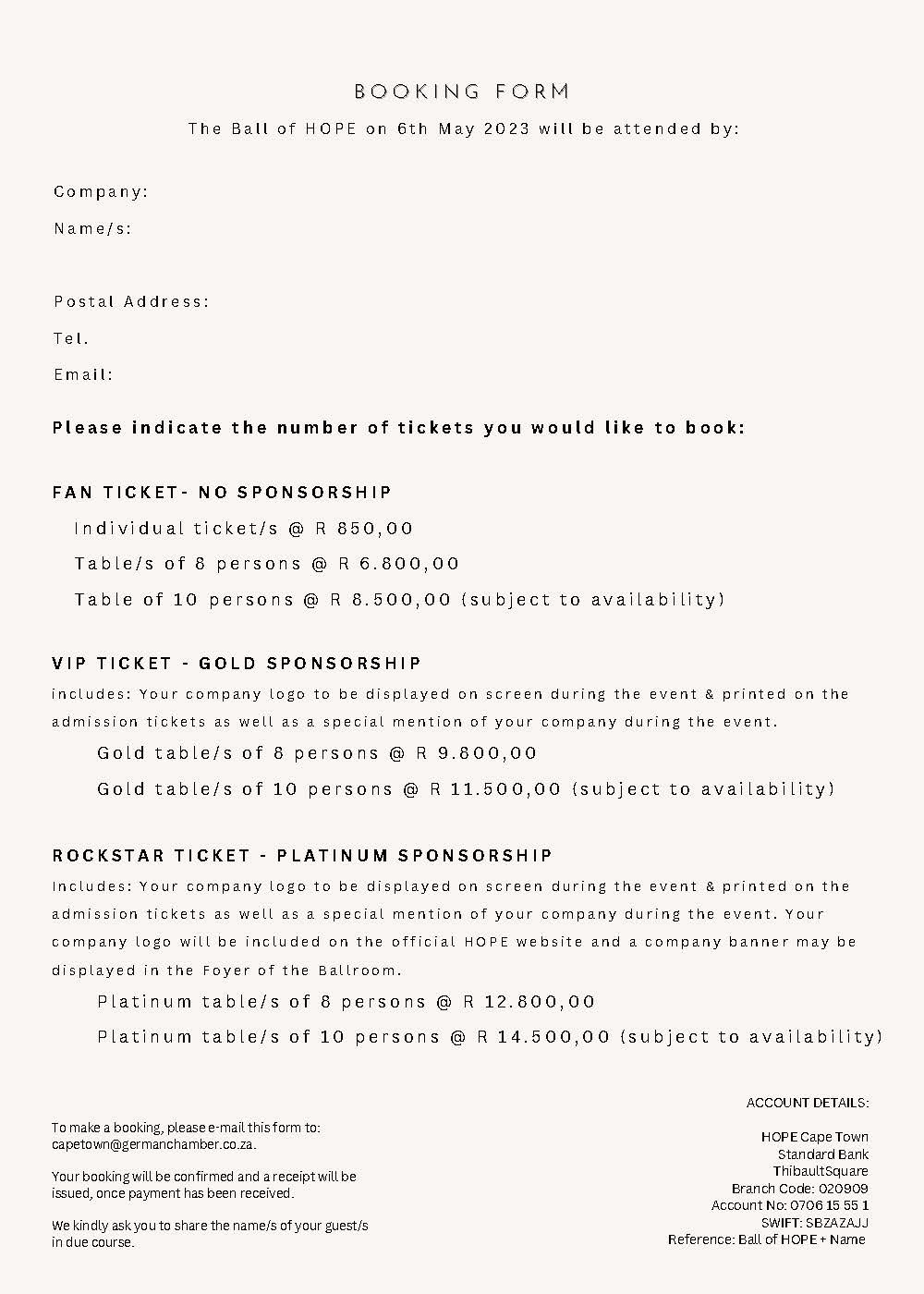
Ticket sales for our 21st Ball of HOPE on Saturday, 6th May 2023 at The Westin Cape Town are now open.

Under the motto “Keep Rocking for HOPE”, this highlight on Cape Town’s annual event calendar promises to be an evening of excellent food, rocking entertainment and great company.

However, it is more than just a fantastic evening – it is a wonderful opportunity to support the important work of HOPE Cape Town!

Please reserve your seat/table as soon as possible to avoid disappointment.

The WESTIN Cape Town has granted our guests reduced room rates at R2300 (per single or double room, incl. breakfast) for the occasion.

For room reservations please contact Leigh-Ann Lyons/The WESTIN directly by e-mail Leigh-ann.Lyons@westin.com

We look forward to welcoming you to the Ball of HOPE 2023!

Yours sincerely,

On behalf of the organisers:

Rev Fr Stefan Hippler                           Anja Tambusso Ferraz

HOPE Cape Town                                SA- German Chamber of Commerce and Industry

capetown@germanchamber.co.za

You can download the form from here

Filed under: Africa, HOPE Cape Town Association, HOPE Cape Town Association & Trust, HOPE Cape Town Association & Trust, HOPE Cape Town Trust, SA-German Chamber of Commerce & Industry, Uncategorized, , , , , , ,

Blog Categories

Follow God, AIDS, Africa & HOPE on WordPress.com

You can share this blog in many ways..

Bookmark and Share

Enter your email address to follow this blog and receive notifications of new posts by email.

Join 2,711 other subscribers

Translation – Deutsch? Française? Espanol? …

The translation button is located on each single blog page, Copy the text, click the button and paste it for instant translation:
Website Translation Widget

or for the translation of the front page:

* Click for Translation

Copyright

© Rev Fr Stefan Hippler and HIV, AIDS and HOPE.
Unauthorized use and/or duplication of this material without express and written permission from this blog’s author and/or owner is strictly prohibited. Excerpts and links may be used, provided that full and clear credit is given to Rev Fr Stefan Hippler and HIV, AIDS and HOPE with appropriate and specific direction to the original content.

This not withstanding the following applies:
Creative Commons License
This work is licensed under a Creative Commons Attribution-ShareAlike 3.0 Unported License.