Who does not want to leave a legacy and be remembered for being a force for good? How fascinating will it be if your deeds are bearing fruit still in a hundred years time. Seeing the bigger picture and being a hero driven by hope and the imagination, how the world could be; and not only imagining it but putting your money where your mouth is….
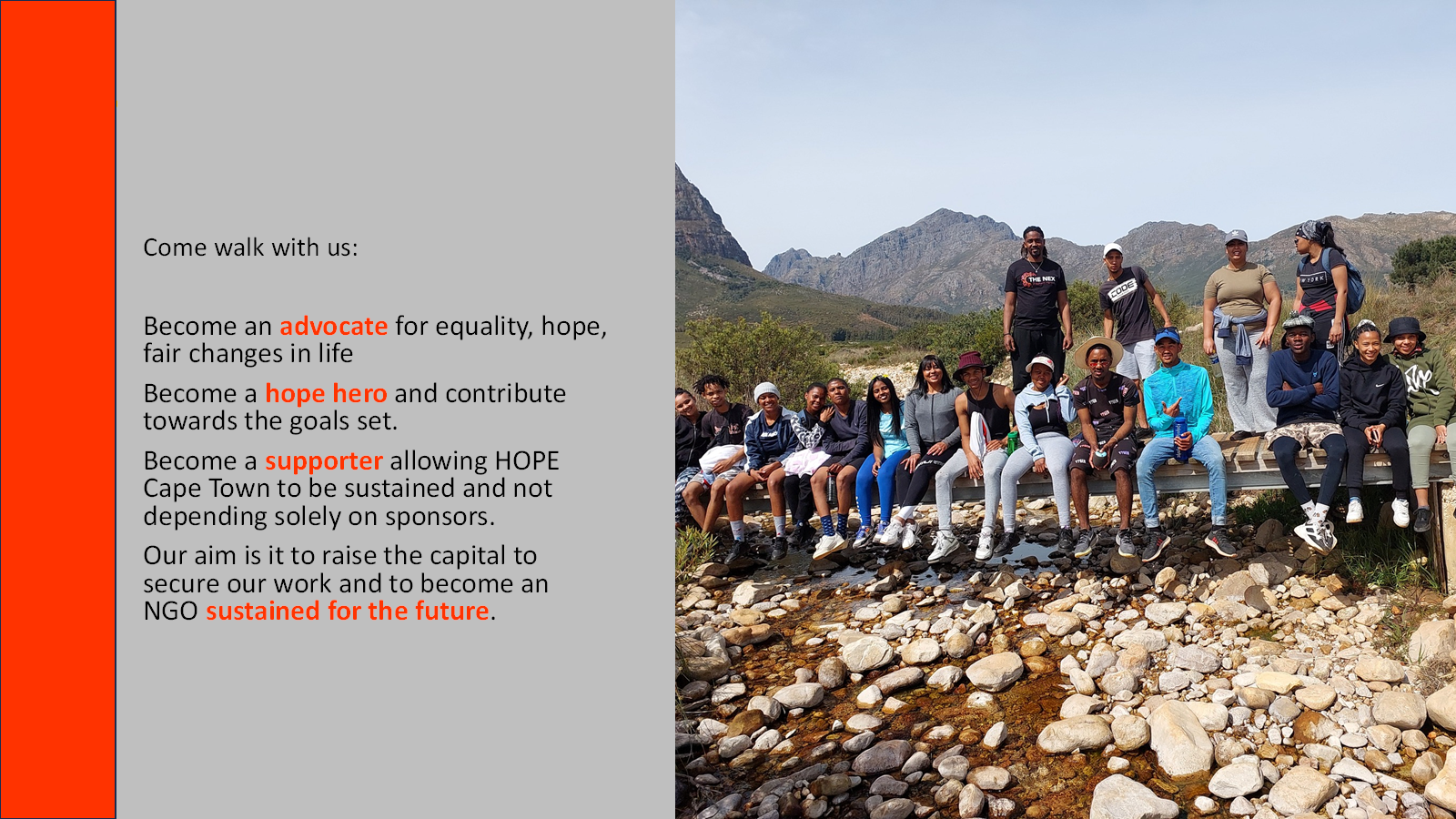
We invite you to do exactly this – walk with us while scrolling down…
Thank you for walking with us until this point. You have certainly done the first steps. The question, which remains, and only you can answer: Do you want to go one step further and become a hope hero in-deed?
If you do, please feel free to contact trust@hopecapetown.org
It is a ringfenced email address and all correspondence remains confidential.
Tax receipts can be issued by HOPE Cape Town in Germany, Austria, South Africa and the USA if the donation to capital is received in the respective local HOPE Cape Town related bank account.
HOPE Cape Town has grown substantially and with it its portfolios. This warranted a new webpage design to allow all the work being presented appropriately. Being holistic means at times also confusing people with the variety of scopes of work.
People can be confused when dealing with HOPE Cape Town. It seems to be one organisation, but there are different additions to “HOPE Cape Town”: either Trust or Association. “What’s the difference?” they ask often.
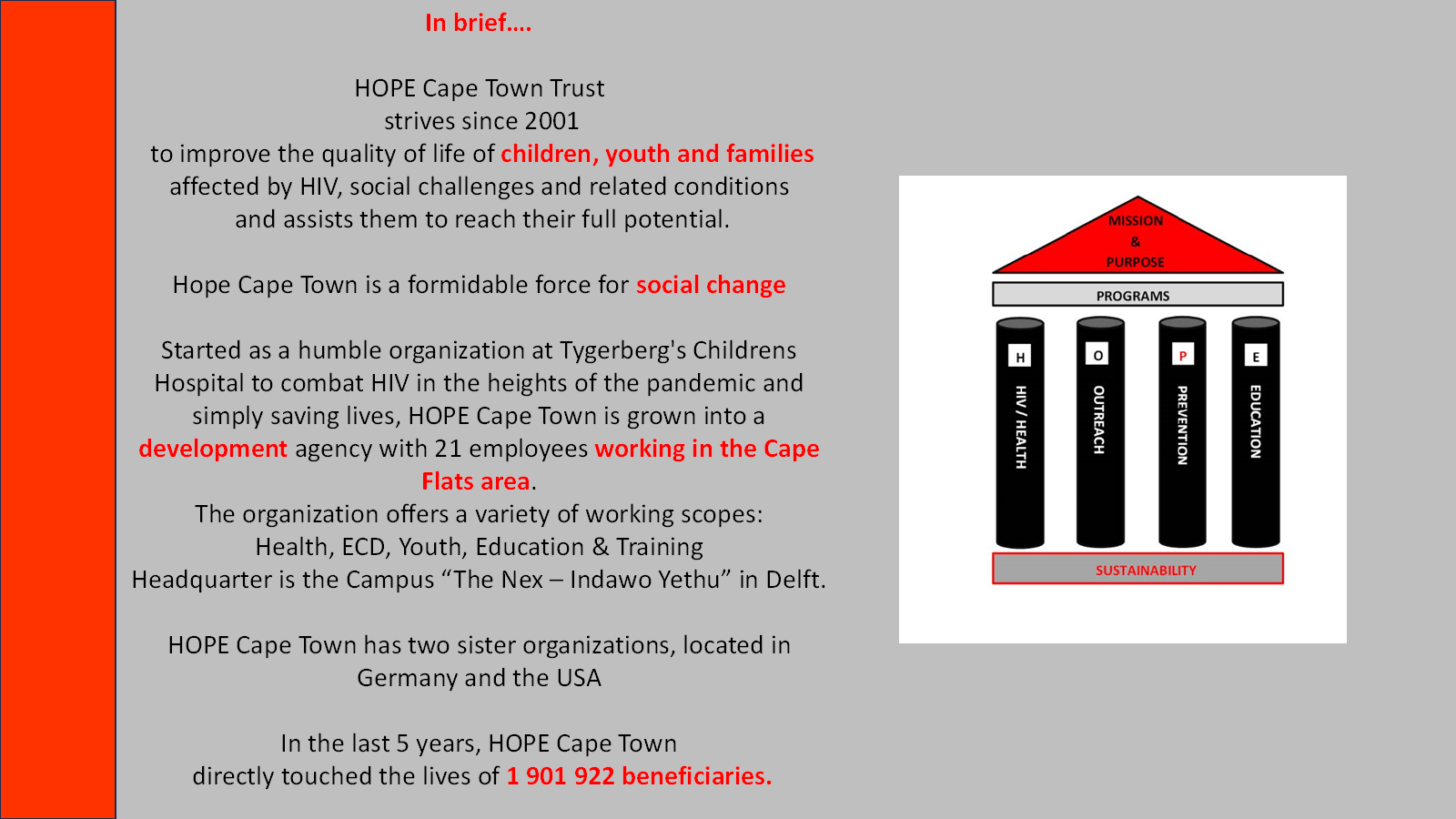
When HOPE Cape Town was founded in 2001, an Association was created and named: HOPE (hiv outreach program & education) Cape Town Association. In the years to follow, the Association grew from a 1 employee organisation with a small board into a more sizable entity.
In 2006 the Board decided after long and intense discussions: There is a need for oversight. The HOPE Cape Town Association should in future be functioning as the working horse. The HOPE Cape Town Trust was founded as an oversight entity, looking after the financials and overseeing the marketing/fundraising part of the organisation. The trustees generally don’t get involved in operational questions, but assist from time to time in a very limited and clearly defined role.
The HOPE Cape Town Trust also became the face of the organisations for all marketing/fundraising related activities.
Once a year, the HOPE Cape Town Association presents the budget to the Board of Trustees, which in turn exams and gives approval to the projected spending.
Both entities, Trust and Association, are each a NPO and a PBO in their own right with all the necessary credentials in South Africa. Both entities have a board – the Association’s board is called the “Board of Expertise”, being exactly this: experts in the various fields of work. The chairperson of the Association is ‘ex officio’ part of the Board of Trustees with voting rights and vice verse.
While the Board of Trustees meets formally twice a year, the Board of Expertise meets quarterly to conduct business.
I always believed that for every founder of an organisation there is one duty which is of utmost importance, whether in a company or in an NGO, and that duty is to secure a smooth and timely succession plan. Ensuring that the transfer of responsibility happens calmly and without too much excitement or disruption is vital for any organisation.
Already in 2018 I engaged with the trustees of the HOPE Cape Town Trust, and together we developed a strategy and created a transition period with clear rules and responsibilities for changes within the organisation.
Dr Izane Reyneke has taken over as CEO dealing with all day-to-day business and Mrs Marlene Whitehead has taken over as program manager of the organisation. Both are working in their new positions now for more than a year with diligence and dedication. Mrs Carole Armstrong Hooper will chair the two HOPE Cape Town Trust board meetings.
In the last two years, HOPE Cape Town has created two new positions to facilitate this transition and at the same time to step up the professionalism of the work done. The launch of the campus “The Nex – Indawo Yethu” marked the beginning of a new chapter in the life of the organization, which made these structural changes even more meaningful.
I will not be disappearing or turning my back on HOPE Cape Town, far from it, my role within the organisation will also change. For the next 2 years, my focus will be on marketing and fundraising for HOPE Cape Town in Europe and the USA. I don’t need to explain the impact, Covid-19 and the ongoing Ukraine war has on fundraising, and it is amazing how the plan discussed in 2018 now fits nicely into what is necessary for the organisation’s sustainability going forward. To cut flight times and to be more flexible, my home base will be Malta for the time being.
I will remain a Trustee, part of the Executive Board and the Finance Committee for the time being. Practically, I will split my time between South Africa, Europe, and the USA. Currently, I spend 2/3 of my time in South Africa and 1/3 travelling, from now on this will be reversed.
To be able to take the initiative to plan and implement ‘stepping back’ into the second row is indeed a blessing, and it also allows the organisation to calmly develop and grow. Nobody is irreplaceable. To sit and to rest on one’s laurels until called to higher service in heaven is not my style, nor does it serve any purpose.
As founder of the HOPE Cape Town Trust, I am looking forward to supporting the organisation in my new role and responsibilities. I am also looking forward to meeting many of our European and US supporters more frequently. It is indeed exciting and a blessing to change roles and being able to serve the organisation in different ways.
My plea to you: Please continue to support HOPE Cape Town in the future. As I always say, we, the people on the ground, are only the extended arm of your generosity and solidarity.
Together, we are the HOPE family, bringing tangible hope to those less fortunate.
Working in the NGO field in South Africa, one often meets a sort of demand for handouts and charity to attract people or fill programs with participants. Also, local politicians are tempted to have give-aways at hand – it seems to be the culture of work in the townships of South Africa.
The argument is frequently that people are too poor to pay – or that indeed as mentioned you don’t get people to come if there is nothing for free or to gain. And not even seldom, those invited to join programs ask for what goodies to expect when joining a program. Not to tell about competition within the NGO sector who is able to hand out more.
I get it – indeed, people are poor and times are tough. And yes, it is easier to attract people with food, gifts, and takeaways. But I doubt that this vouches for respect, dignity and development.
Free handouts make people dependent; handouts are charity and needed in absolute emergency situation to stabilize people and to giving them a perspective.
But to change the situation of people, and to foster a non-dependence relationship; to sustain a path to a better life, NGO’s need to walk with people in a giving / contributing relationship. And this does not always have to do with the exchange of lots of money. Small contributions chipped in. Offering talents and time as a contribution. The results:
The acknowledgement of self-worth and the value of what is being offered or jointly worked on. The feeling of being partners on eye-level and respectful towards each other. And the learning curve resulting from all of these aspects: more dignity, more self-respect and the knowledge: I can do it – we can do it together.
All this needs a shift in mindset in all sectors of engagement. It requires the courage to walk the talk of real development; a walk which can be rough and at times scary. But it is the only way to better the lives of people sustainably and to make everybody a real participant and less a dependent waiting for the next handout.