God, AIDS, Africa & HOPE

Reflections / Gedanken

NGO’s in the times of madness

Watching news in our days is not for the faint-hearted. Ukraine, Gaza, Sudan are reminding us every day on the brutality of life. The current storms in the Western Cape, the early hurricane season and the heat-waves are making it very clear that nature was not a top priority for human mankind – and that we have to catch up to survive. Politically the drama around the US election, the strengthening of right-wing and fascistoid political forces in Europe, only topped by the semi-religious authoritarian white macho cult around the man, who claims to make America great again questions the well-being of democratic systems. African countries continue to have their very own challenges.

It seems that after the pandemic and all the shutdowns with their often nonsensical rules have created a deep mistrust into politics and triggered the yearning for simple black and white solutions.

But not only that: it becomes more and more difficult to determine what is right and wrong. One could for example that the impression that bombing a school or a hospital has different moral implications depending on who fires them in a war. Looking at the reporting of the wars in Gaza and Ukraine, the ambivalence of reporting and making ethical judgements on the terror, people have to endure becomes visible. It becomes very confusing – even on a sub-conscience level – and this created another grounds for the liking of black/white solutions.

If you look at all the crisis – one of the consistencies you will see is the work of NGO’s. If there are real and legit, they don’t follow politics and public opinion, but they see the person as a human being, they see the victim of unrest, the victim of social disadvantage, the situation of helplessness – and they care, they walk with the people, they change the perception of people being causalities to being again a human being.

How much more suffering would we see if brave doctors and medical staff of non-governmental organisations would not dare to stay in Gaza, knowing that their life is on the line?
How much more suffering would we see if NGO’s in Europe would not organise assistance into Ukraine?

But we don’t have to go to extreme situations.

Looking at the HIV pandemic in South Africa around 2000 – what would it have looked without NGO’s at the forefront of assisting those living with HIV – even going to court to force government to stop the neglect they defended till it was legally not possible any more?

Looking at Covid, but also at the continuous challenge of poverty unemployment, GBV, refugees… You name it. It is the NGO sector and civil society keeping often situations from collapsing into chaos. It is the grounded work of small and big role-players in this sector doing so.

Looking again at the bigger picture, one can observe that especially authoritarian regimes like to prohibit NGOs, especially when they are receiving international funding. Russia and Egypt are two examples, you hear now also such suggestions even from a certain part of USA politics.

Obviously, NGO’s also have black sheep in their midst and not seldom, ideologists and fundamentalists as well as lobbyists create NGO’s to hide their intentions. Those attempts undermine the work of true NGO’s, and it seems to be difficult in our digital age and time to determine on first sight, which organisation is legit with no hidden agenda. Sometimes only time will tell.

But at the end, we all should realise the importance of the small and big, the local, national and international non-governmental organisations keeping the balance and contributing to our society in a way, people often not realise. They also remind us about our own humanity in the times of madness.

Filed under: Networking, Politics and Society, Reflection, Society and living environment, , , , , , , , , ,

Explainer: HOPE Cape Town – Charity versus Development

Travelling in Europe and the USA trying to tell the story of hope to the respective attentive audiences and to introduce our work, I am very often confronted with the word “Charity work”.

People, especially in the religious or humanitarian context, see HOPE Cape Town and its work in the context of “charity”. We collect money to help poor people – to say it in simple word. And obviously as a religious or humanitarian person, you give a contribution via the organisation to assist those in need.

“Those in need” – indeed this is charity when you help those who are in dire need, who are in a direct and life-threatening emergency. Charity means to feel with those who are in situations turning their lives upside down. And yes, HOPE Cape Town has in some segments of work also this charity aspect: giving out meals, handing out cloth is charity work.

But HOPE Cape Town does not define itself with “charity”alone – we pride ourselves of being a development agency. That sounds big and almost governmental – most people think of the respective government departments spending money on big projects via the foreign government entities; often in the knowledge that it is triggered rather by political interests than real needs. And obviously being aware that often not all money is reaching the goalposts set for the specific project.

Development, as we understand it, means indeed walking with the people we encounter. It means to sit and listen first to what the needs are instead of what we think is needed. It means to discuss matters, include all considerations and to make at the end joined decisions. Furthermore, it means to take people seriously, to discover the wisdom of people with different thinking – and sometimes it also means to run against a wall and to knock your head before being successful.

This development work is in our understanding the only way to sustain changes, to allow growing in personal lives, but also communities and to strive for a better world.

And “the better world” means that development does not end there. To really change the world on all levels there must be a clear understanding, that the impact is not alone – in our case – in South Africa – but that there is a two-way road back to Europe and the so-called developed countries.

The world is currently changing massively and only if we allow for encounter, for touching each other’s life and mindset, we develop an understanding for each other which is an added fertilizer for tomorrow’s better world. And those encounters have to be on eye-level. Some people say, the West has the money, the South the humanity and wisdom – whatever it is: only if we want to develop jointly we have a chance to create a world where the next generations will be delighted to live in. We owe it to them.

So development as we see it at HOPE Cape Town, it is like a bridge bringing worlds together to walk together and to reflect together to make sense of the colourful diversity and to show that nobody is an island any more. We need each other to overcome all the challenges be it social, economic or environmental.

Filed under: Africa, General, HOPE Cape Town Association & Trust, HOPE Cape Town Trust, Networking, Politics and Society, Reflection, Society and living environment, The Nex - Indawo Yethu, Uncategorized, , , , , , , , , , , , ,

Explainer: HOPE Cape Town USA

Next to HOPE Cape Town Association, HOPE Cape Town Trust and HOPE Kapstadt Stiftung there is another sister NGO called HOPE Cape Town USA.

During the Word Aids Conference in Washington / DC many years ago it became clear, that the HIV prevalence rates in Washington or Dallas within the non-white communities were comparable with those horrific numbers in South Africa.

Same problems, but certainly different situations and different ways to tackle the existing challenges. Rev Fr Stefan Hippler, who attended the conference, brought the stats and situation analysis with back to South Africa. Meetings with the then Head of Social Services in a New Jersey county Mr Joe Kunzmann and a lawyer from Dallas, Mrs Stacie McNulty Greskowiak led to the formation of HOPE Cape Town USA.

The entity was meant to explore synergies between the work in the fields of HIV/AIDS in both countries. Connections were established to local NGO’s and HOPE Cape Town via HOPE Cape Town USA and promising leads developed. The pandemic destroyed most of the plans and HOPE Cape Town is slowly finding its feet again.

In November 2023 the first fund-raiser was held in Ann Arbor / Michigan, where one of the 4 directors now resides. Further steps of local engagement as well as fundraising efforts are in planing.

HOPE Cape Town USA is a recognized NGO in the USA with the ability to issue tax-deductible receipts and the directors are currently:

Chair: Joseph E Kunzmann (Somerville / New Jersey) Treasurer: Somerville / Shirley Kunzmann (New Jersey) Secretary: Stacie McNulty Greskowiak (Michigan) and the two members Auntjuan Wiley aka Mr Community” (Dallas / Texas) and Stefan Hippler (representing HOPE Cape Town Trust South Africa)

Filed under: Africa, HOPE Cape Town Association & Trust, HOPE Cape Town USA, Politics and Society, , , , ,

Struggle of fundraising in our times…

Focusing on marketing and fundraising for the organisation HOPE Cape Town in South Africa, I had the pleasure – if it is a pleasure – to travel between three continents this year again, trying to find, reach and convince people in the USA, South Africa and European countries to support our holistic approach.

It is generally not an easy task, but the world is currently so much up-side-down, that the challenges seem to grow every day. It becomes a minefield, not only, because of money being diverted for current affairs but also as ideology, insecurity and anxiety are more than ever factors of life.

Gaza and Israel, it seems that you have to put every word on the golden scale to not offend but toe the line to stand on the right side – whatever that may be. Looking at the human factor without politics, as NGO’s do, is a difficult option as you’re directly under general suspicion of supporting terror.

The war in Ukraine means fundraising for people in a country, in which the leadership without any shame stands with the aggressor and pretends to be neutral.

South Africa’s grey listing and constant corruption on the highest levels are often points of debates with funders. They believe that South Africa has enough resources if and when the elite stops stealing money.

The USA is currently in an epic battle when it comes to democracy and a hotbed for the attempt to mix white superior religion, clearly visible in proclaiming a certain candidate a Godsend. Not to forget, a leader of the House who has direct conversations with God and is not the new Moses. In some states, history is rewritten and books are banned again. Not really an ideal environment to discuss support for people in South Africa.

Generally, Covid and the restrictions seem to have a profound effect on people, who felt that the security and safety their life was build on, was gone in seconds. It shows still today in actions, reactions and behaviour.

Business people in Germany, but generally in Europe, are more than worried about the current economic situation in the country and the direction, they are taken by those politically in charge.

All this impacts the world of fundraising a great deal, it makes it perfectly clear, that depending on donations alone is not sufficient for the long run. NGO’s like companies have to build up and maintain a reserve like any other companies if they want to survive long term and meaningfully.

It also makes it necessary to speak with people face to face – not FaceTime, not zoom or teams. Those can be interim measures to keep contact, but the person encounter is in times like ours the most essential part of fundraising.

The need to navigate between the world of possible funders and the reality of the recipients becomes more tricky as sensitivities and anxieties looking at the future reign high.

All this makes the work of NGOs like HOPE Cape Town even more important, because the victims of all the political, social and economic turbulence are those anyhow at the bottom of society. Those who lost out by birth are loosing again. NGOs are the lifeline to survive and even to grow under these circumstances.

We as NGOs need, besides the normal donation also people who want their support working for years to come. We need people investing in the future of others long-term, and so becoming role models for the next generation they helped to form and sustain.

Not only that, but we need this support to be able to stand firm in our support for human dignity and human rights declared for everybody. There are shifts of proportion happening now when it comes to demography, political influence, economic powers. NGOs are essential in those times, balancing what often is overlooked in daily struggles on the world stage. A reason more to support, sustain and to invest in the non-governmental sphere of society.

www.hopecapetown.org

Filed under: Africa, HOPE Cape Town Trust, HOPE Cape Town USA, HOPE Gala Dresden, Politics and Society, Reflection, Society and living environment, , , , , , , , , , , , ,

Why should we support an NGO in Africa?

“Why Africa?” is a phrase I often hear when I present the work of HOPE Cape Town. Two weeks ago in Bitburg at the Secondary School I was discussing the question of why young people in Bitburg / a little town in Germany, should be interested in what is happening at the very bottom of the African continent.

“We have our own problems: the war in Ukraine, the many refugees, the economic situation, the climate” – and those, they tell me, “are more important to us than South Africa at the moment.”

The sentiment is right – and Corona and the experience of powerlessness during the pandemic, as well as the government measures that were often perceived as excessive during this time, have massively increased the anxiety and insecurity of many people. Many people’s sense for security has been eroded in times of Covid-19; this has long-term consequences.

But feelings are not always the whole reality – and it seems difficult to understand the complexity of life and interdependencies far beyond borders and distances.

Take the refugee issue in Germany: 2015 was a year Germany felt the influx of refugees in a very special way. But long before 2015, it was clear to anyone who wanted to know that Europe would have a problem that would be massively exacerbated by the climate issue. War, hunger, but also the simple human impulse for more security, prosperity and that children should have a better life are pushing people to flee or embark on the – often supposed – journey to a better future. This has also become a highly attractive business that promises massive profits for human traffickers as well as security companies. And it has become a political pawn between European countries and interests – see Hungary or Turkey, for example – and a bargaining chip for decision-making in the EU and beyond.

People stay at home when it is peaceful and there is a chance to live safely. Nobody sets off on an uncertain journey just for fun or because it’s funny. Sheer economic hardship is also a serious reason for people.

I don’t have the impression that much has really changed on this issue in Germany since 2015. Development policy has not really changed fundamentally. And the political landscape that increasingly consists of professional politicians. They are often distanced from the realities of ordinary people as a result – and their focus is often limited to the next election – they often fail terribly to see the bigger picture, which also includes the far-reaching complexity of matters in our days. Perhaps we also need to think about how politics should be structured differently in such a rapidly changing and evolving world. And whether it should be entrusted to professional politicians; some of whom who never have learned or practised a profession or trade, is another important question.

But back to the question of why people in Bitburg, or let’s say in Germany, should take an interest in what is happening in Africa and do something about it?

The mass exodus of people will not be stopped if money flows through the governments in Africa, which take their “cut” and whose corrupt actions are known and almost factored in.

The problem of refugees will not be solved as long as the economy is mostly seen to benefit Europe and adding value does not take place on the African continent.

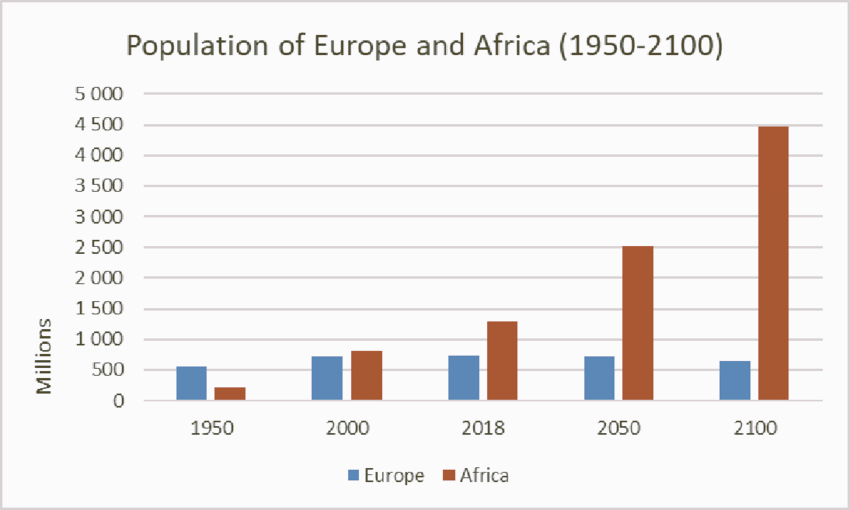
Africa will have the youngest population in 2050 – and therefore consumption and work will take place on this continent. We are facing massive upheavals not only in terms of the climate, but also in terms of the future of the world’s population, the future of work distribution, which people in Europe need to take into account now. We should avoid that in 30 years’ time the old saga repeats again that nobody saw this coming. The run by European politicians for green hydrogen from Africa shows where the journey is heading. The economic stagnation of many African countries is now becoming an advantage when it comes to renewable energies.

For this reason alone, Africa is important. And also South Africa, which is still a major player in African politics and is often used economically as a gateway to Africa. It should be mentioned in passing that South Africa has taken its share of refugees from Somalia to Zimbabwe. Anyone who looks at the numbers of internally displaced persons in Africa knows how critical the situation is and how few refugees actually arrive in Europe.

We are facing tectonic shifts as humanity, as societies. Europe not really looking beyond their own backyard, thinking only nationally or Eurocentric  – even if that is currently “in” – is simply short-sighted and will exacerbate the problems in Europe even more. No one is an island, no one can do it alone: climate, hunger, war, demography in a country and so much more require global solutions.

To break it down and put it simply: we as humanity, as a society, must ensure that wealth, added value, security and future prospects are available in every country (in Africa there are 54 countries covering 30 million square meters). We can only achieve this by working together and with an honesty and willingness to cooperate that can certainly be improved at present. Far-sightedness is required, and solidarity that ultimately also serves those who exercise it. Africa is a continent of the future, and Europe should align its policies accordingly. And NGOs are important points of contact here because they work at a level that enables decision-makers to see and understand realities. They often do very local but crucial groundwork on which society and politics can then build. Supporting NGOs in Africa is far more than charity; it serves the future security and peace of all, especially in Europe.

Filed under: Africa, General, Politics and Society, Reflection, Society and living environment, Uncategorized, , , , , , ,

Blog Categories

Follow God, AIDS, Africa & HOPE on WordPress.com

You can share this blog in many ways..

Bookmark and Share

Enter your email address to follow this blog and receive notifications of new posts by email.

Join 2,711 other subscribers

Translation – Deutsch? Française? Espanol? …

The translation button is located on each single blog page, Copy the text, click the button and paste it for instant translation:
Website Translation Widget

or for the translation of the front page:

* Click for Translation

Copyright

© Rev Fr Stefan Hippler and HIV, AIDS and HOPE.
Unauthorized use and/or duplication of this material without express and written permission from this blog’s author and/or owner is strictly prohibited. Excerpts and links may be used, provided that full and clear credit is given to Rev Fr Stefan Hippler and HIV, AIDS and HOPE with appropriate and specific direction to the original content.

This not withstanding the following applies:
Creative Commons License
This work is licensed under a Creative Commons Attribution-ShareAlike 3.0 Unported License.