God, AIDS, Africa & HOPE

Reflections / Gedanken

POZ Magazine: Cure Watch…

In December 2010, a man was declared cured of HIV. While his example won’t be widely repeated, it could lead to more useful strategies for a cure.
Timothy Ray Brown is “the Berlin patient.” He needed a stem-cell transplant to fight recurrent leukemia. His doctor, Gero Huetter, MD, knew that a small percent of people of northern European ancestry have a genetic variant called double CCR5 delta-32 deletion that seems to protect them from HIV. The virus attaches to CCR5 receptors on CD4 immune cells in order to enter and infect the cells (another attachment protein, CXCR4, is less commonly used). People genetically prevented from producing CCR5 receptors don’t contract HIV despite exposure.
For Brown’s transplant, Huetter found a match who had the genetic variant. After two transplants, Brown found that his HIV receded along with his cancer. Now, nearly four years after the second transplant, he remains free of HIV—without meds.
This cure is not widely useful, and not only because of its expense. Stem cell transplants rank among the most dangerous of medical procedures. Also called bone marrow transplants, they involve wiping out the immune system with high-dose radiation and chemotherapy before infusing stem cells from a donor. The body then grows a new immune system matching the donor’s. During chemo and radiation and before the new immunity takes hold, the recipient is vulnerable to infections and at serious risk of organ damage and other life-threatening conditions. There is also significant danger that the recipient’s body will reject the transplant.
Yet Brown’s case opens vistas for HIV eradication. While meds (entry inhibitors) blocking CCR5 attachment are in the HIV-treatment arsenal, they do not erase the virus and must be taken continuously. Brown’s experience shows that if CCR5 receptors can be genetically altered, the virus might be wiped out, making a lifetime of HIV meds unnecessary.
Researchers are working on exactly that, using technology called “zinc finger DNA-binding protein nuclease” to modify CD4 cells to match those of people with the double CCR5 delta-32 deletion. Several current studies ask whether infusing such cells—without the life-threatening transplant—will allow the Berlin cure to go global.

POZ magazine original article

Filed under: HIV and AIDS, HIV Treatment, Medical and Research, , , , ,

POZ Magazine: HIV Drug Development Stalls

Companies that develop HIV drugs are at a standstill in bringing new medicines to market, Bloomberg reports. Of the 31 HIV meds on the market, only six were approved after 2004; Intelence was the last drug approved—and that was three years ago. The newest antiretrovirals are much safer and more effective, have fewer side effects and must be taken less frequently. As a result, the bar for bringing new drugs to market has gotten higher and fewer drugs are in the pipeline. This also means that HIV-positive people who develop drug resistance have fewer treatment options.

Source:  Poz Magazine

Filed under: HIV and AIDS, HIV Treatment, Medical and Research, , , ,

Radioactivity

Besides all the news about the bus bombing in Jerusalem today and the war games in Libya – Japan still maintains a role in the news on TV. And listening to the news about more and more radioactivity in food, in water, in the air and the evacuation of all workers of Fukushima Nuclear Plant I ask myself whether we really grasp the reality we are facing. Looking at the pictures of destroyed cities – empty shops, no electricity, no petrol: a whole system, praised as one of the most efficient and technology wise advanced nations has come to a still stand and the radioactivity in the nature and the sea will not go away soon. Most probably at least one generation will be constantly reminded of the disaster.

It is the second time, Japan is hit from the nuclear power – the bombs on Hiroshima and Nagasaki are still vivid memories for the Japanese people.

I read from Bishop Williamson, that he connects the disaster with the sins of the people and that God uses such punishment to bring people to re-think their doing. What a nonsense – what an abuse of a catastrophe for a meaningless theology – abandoned in that form a long time ago. God protect us from those Pius-brothers, they are really a pain in the neck of our church trying to recover from all the bad news of the last years.

It seems that most people have lost the ability to comprehend what is going on – the consequences of natural forces and that within minutes, our ordinary life is gone – as the people of a nation, a community or also in a private capacity. It reminds me that also other disasters like HIV/AIDS seems to be so incomprehensible that one stops thinking really of it, because it is “the others”, not me, not us. It is far away – it cannot happen to me, to us, to our family. Or the question of the millions dying of hunger every year, while we throw away food and subsidies destroying food in the rich countries or for farm products never been sold.

For me, the Japanese tragedy reminds me, how short-sighted we are and how we push away all thoughts, which would mean troubling thoughts on a long term run. Which would push me to give answers on questions I don’t want to be bothered with… Which maybe ask me to acknowledge that this world is still “in creation” as the bible put it – not ready, not in harmony – and even not giving an answer to the question “why””.

Be the work in the fields of HIV/AIDS or be it the tragedy in Japan – I hope I led all these questions to bother me as long as I live and challenge me to search for new answers every day.

Filed under: General, HIV and AIDS, Reflection, Uncategorized, , , , , ,

Sunday evening blues..

Sunday eve in Fallersleben – and a long travel week draws to a close while another is just beginning. The last three days were intense: the last meeting of the team trying to move the world, not only alone and in 100 days but with many more supporters and with a move, which will be felt for years to come. At the same time, while I am sitting here close to Wolfsburg and trying to get my mind around safety tips for the trip, fundraising concepts and much more, at home in Cape Town we are busy to shortlist the applications for the directors post. The ability to bi-locate, to be at two different places at the same time remains wishful thinking, but would be necessary on such days. Not to forget that the administration of the “Bundesgartenschau” in Koblenz wishes urgently to have the plan for October, when we will have “our day” of AIDS awareness and prevention within the framework of the show. A whole day, the podium is ours and together with the AIDS-Hilfe Koblenz we have to fill the space months in advance.Even being at two places at the same time seems not enough.. 🙂

But moving the world requires multi-tasking – but also requires the support and the network of each and everybody. In the times of the internet this may mean to visit websites:

www.waae.de
www.hopecapetown.com
www. hopegala.de

are three of those close to my heart on this Sunday eve. Where ever you are, reading this, you can be part of a big movement, you can contribute whatever you can – in ideas, in time, in donation, in the one Euro, which we need from 5 000 000 people to make our move becomes a reality. It does not matter where you live – in Germany, in South Africa or somewhere else along the way of our expedition or far away: you have a constant invitation to join in and to spread the message of hope and future and even to be a piece of this hope for others.

Filed under: HIV and AIDS, HOPE Cape Town Association & Trust, Networking, Reflection, Uncategorized, , , , , , , ,

Move the world

Move the world – in 100 days around the world

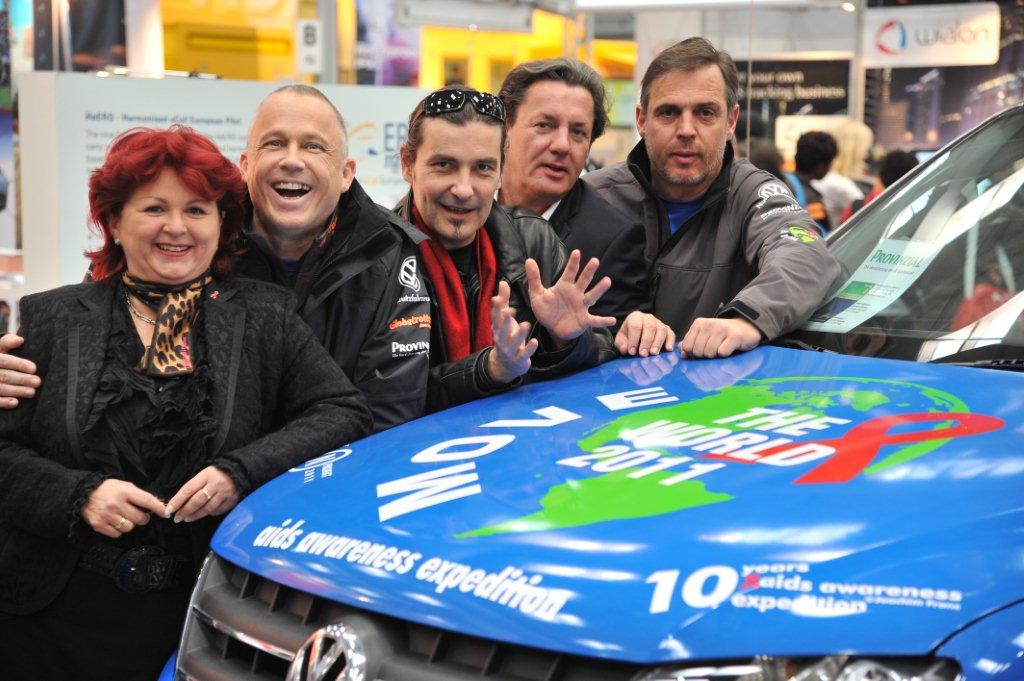
Joachim Franz launches his to date biggest “aids awareness expedition”

Under the leadership of AIDS activist Joachim Franz, mid April a convoy of 5 pick-ups will start their tour around the world. It is an adventure which might be a first of its kind.  12 men and women will conquer the world with the special mission: to move the world and to keep on challenging the HIV/AIDS pandemic. Then still 30 years into the pandemic, the figures are frightening: 33 Million people worldwide are carrying the virus; in 2009 1.8 Million people have been dying as a consequence of their HIV infection.

W = World

Vancouver in Canada will be the starting point of the expedition. From their, Joachim Franz and his team will follow a route around the world, which resembles a big “W” on the world map. North, Middle and South America, Europe, Africa and Asia are part of the 65 000 km route, ending in Australia with an imaginary point behind the “W”. Covering all continents also mean to connect the rich and the poor countries of this world: the rich ones, where HIV means to live with a chronic disease and the poor ones, where HIV means still in most instances death for many reasons.

Donation concept

Supported by the German Foreign Minister, Dr. Guido Westerwelle as patron of the expedition, the challenge is partnered by UNAIDS, the German AIDS Foundation, the German Embassies in the respective countries and other important representatives from the cultural and economic sector. In 50 countries, the participants of the expedition will meet with local and national representatives of the respective countries to understand the HIV/AIDS situation of the country, but also to challenge each and everybody to be part of the fight against HIV and AIDS. People who want to join the cause are asked to donate 1 Euro each – and in doing so supporting the creation of training facilities on all continents to intensify and optimize the work in the fields of HIV and AIDS.

Hardness test for men and material

The extensive route around the world passes different climate zones and unpredictable weather conditions. The vehicles must survive a tough ride over asphalt, pothole roads, gravel, sand and slick. But Joachim Franz and his team are well prepared: Five VW Amarok, fitted with the most modern navigation technology and each equipped with a 163-PS-TDI motor as well as double turbocharging and Commonrail open consumption direct injection, shiftable four wheel drive, rear suspension lock, terrain reduction and underride protection will take the challenge.  Under their hardtops all material is stored: water, equipment and all possible spare parts.

The double cabins will be the working, living and dining room of the team, and if there is resting time, mounted roof tents will provide some shelter. All team members are volunteers and they are coming from all walks of life: Company employees, student, worker, technician, pilot, Catholic priest, paramedic, pilot, entrepreneurs complimented by a team from the media to report on the progress in word and picture. This expedition will be a test of durability for men and vehicle and – due to the fact, that round tables and flights are fixed by day and time – a race against time. Who knows Joachim Franz will recognise this mixture of sportive challenge and HIV/AIDS awareness. Since already 10 years he mixes sports and adventure to make people aware of the HIV/AIDS pandemic and the consequent suffering of those affected and infected. Donation money collected in the last expeditions support projects around the world, amongst others projects in South Africa, Asia and South America.

From toolmaker to the European of the year

Joachim Franz discovered his vocation while doing extreme sports – and always he encountered the plights of HIV and AIDS, be it in the townships of South Africa or the hospices in Manila or the homes for former prostitutes in Nepal. He invented the “aids awareness expedition” as his trademark to combat the HIV and AIDS pandemic. In the last 10 years he mountain biked the Sahara, he ran Marathon in South Africa, took on the Pan Americana by bike, conquered the 20 highest mountains between the north cape and Cape Town and added several extreme accomplishments involving the Pik Pobedy (7349 m) close to China or the Aconcagua (6959 m) in the Andes. For his dedication he was elected “European of the year” (Readers Digest Europe) in 2009, he was awarded the “Prix Romantik Liebold” of the Romantik Hotel Association and in 2010, he was the laureate of the HOPE Award in Dresden. “Move the world marks now the culmination of this idea: to move the world with a team of like-minded people through audacity, endurance and power – a way hardly tried by anybody else in this combination.

The globe is rolling through Europe

Besides the expedition a fundraising effort is launched in Europe with inflatable globes: A second team will travel through Europe and invite everybody to support the expedition – in pedestrian zones, schools, companies. Latter can order such big or small globes to do their own projects in support of the “move the world” expedition. People are invited to send in photos with themselves and the globe and showing so their solidarity with the expedition.

Filed under: HIV and AIDS, , , , ,

Blog Categories

Follow God, AIDS, Africa & HOPE on WordPress.com

You can share this blog in many ways..

Bookmark and Share

Enter your email address to follow this blog and receive notifications of new posts by email.

Join 2,711 other subscribers

Translation – Deutsch? Française? Espanol? …

The translation button is located on each single blog page, Copy the text, click the button and paste it for instant translation:
Website Translation Widget

or for the translation of the front page:

* Click for Translation

Copyright

© Rev Fr Stefan Hippler and HIV, AIDS and HOPE.
Unauthorized use and/or duplication of this material without express and written permission from this blog’s author and/or owner is strictly prohibited. Excerpts and links may be used, provided that full and clear credit is given to Rev Fr Stefan Hippler and HIV, AIDS and HOPE with appropriate and specific direction to the original content.

This not withstanding the following applies:
Creative Commons License
This work is licensed under a Creative Commons Attribution-ShareAlike 3.0 Unported License.