God, AIDS, Africa & HOPE

Reflections / Gedanken

Silence or the aftermath of a living legend

Done – the 10th HOPE Gala in Dresden is part of history and most guests from far have left the city again – others have returned to their daily struggle in so many different ways. There is always that feeling of emptiness after such a big event – memories are formed, thoughts are structured and emails and pictures and newspaper clips remind you on what happened not so long ago.
Silence – I can hear the silence breaking through after days of meetings, encounters, celebrations, dinners, touching moments – and one is again alone with oneself.
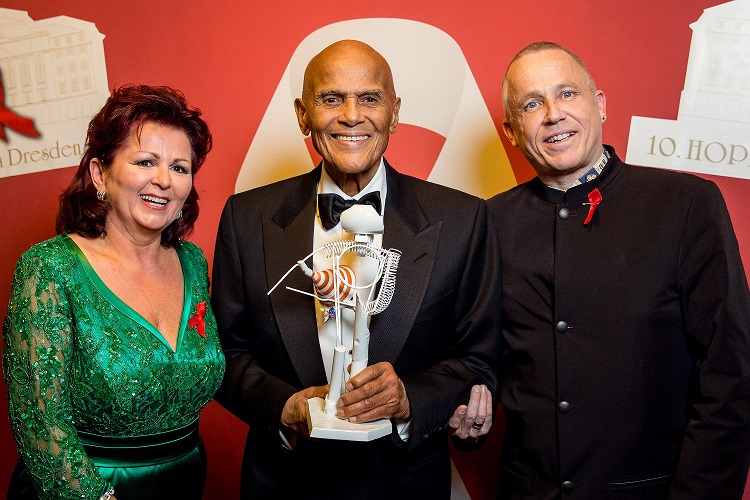
But one memory is sticking in my head – another encounter with the living legend Harry Belafonte, “Mr B” as his daughter Gina called him. Charity dinner and HOPE award – and some moments of having a conversation with him. Movie clips recall the first black entertainer appearing on US TV together with a white performer. A friend of Martin Luther King, part of the black movement and the march onto Washington; his fight for civil rights in the USA, his travels and advocacy for Africa and especially South Africa and his friendship with Nelson Mandela – all coming to life in a 10 minute trailer during the charity dinner. But one sentence is still stuck in my mind: “I have never thought that I will campaign and fight for the same things 50 years later again”, he recalls while attending to racial violence in the suburbs of US American cities.
With 88 years, it seems the conclusion is that the fight never stops and that one can do so little only to be change the world or parts of it. But at the same time he is such an inspiration and encouragement while speaking and sharply analyzing the situations of todays world and confirming that he believes in the goodness of humanity.
And he is charming – telling me that “Fr Stefan and Pope Francis” are giving him hope for the Catholic Church and reconciles him a bit as a born Catholic with his church is obviously music in the ears of a priest working in South Africa . But it is also more than flattery after his also long personal struggle with the Catholic Church. And it does not end there: He has the ability to encourage and touch the lives of people instant and with a smile and an aura I have only so far experienced when I met Nelson Mandela. One can feel the struggle, the wisdom and the maturity, but also the goodness of a person without making him an instant saint – he remains human and looking at eye level.Silence – and somehow lots of faces are appearing in my mind – all those people I met during the events in Dresden, all the people who simply gave up time and / or money to come to attend, to support, to give, to share, to participate, to contribute and to make sure that Dresden is heard in this world as a city with heart and soul caring for those infected and affected by HIV and Aids far away in South Africa. For me that is another magic to be touched by the friendliness and commitment of thousands of people in the last 10 years being faithful to one cause – not letting us down but continuing to believe that sharing is making the world a better place. Ubuntu in the best sense of the word.

Silence outside, but inside there are volcanic eruptions of thoughts, of gratefulness, of yearning for a better world, for bridging the gap; there is exhaustion and joy, but also the resolutness to stand up and walk another year in the hope of touching lives and bridging gaps to better the world by assisting those less fortune. And the hope that one day this seemingly endless struggle succeed and the world is a better place for all. Remember these words from the son “We are the world..”? A song Mr B organised to make us all aware of our responsiblity – until today.

I want to conclude this silent reflection with a thanks to Saxonia Systems, Viola and Hermjo Klein, ParX and Michaela Gornickel and her team and all involved in the 10th HOPE Gala in Dresden. You are all in my heart which is grateful forever.Foto Michael Schmidt vl Viola Klein Harry Belafonte Stefan Hippler001

Filed under: Catholic Church, General, HIV and AIDS, HOPE Cape Town Association & Trust, HOPE Cape Town Trust, HOPE Gala Dresden, Reflection, , , , , , ,

Address of Pope Francis concluding the Synod Session on Family

Dear Beatitudes, Eminences and Excellencies,
Dear Brothers and Sisters,

I would like first of all to thank the Lord, who has guided our synodal process in these years by his Holy Spirit, whose support is never lacking to the Church. My heartfelt thanks go to Cardinal Lorenzo Baldisseri, Secretary General of the Synod, Bishop Fabio Fabene, its Under-Secretary, and, together with them, the Relator, Cardinal Peter Erdő, and the Special Secretary, Archbishop Bruno Forte, the Delegate Presidents, the writers, consultors and translators, and all those who have worked tirelessly and with total dedication to the Church: My deepest thanks! I likewise thank all of you, dear Synod Fathers, Fraternal Delegates, Auditors and Assessors, parish priests and families, for your active and fruitful participation. And I thank all those unnamed men and women who contributed generously to the labours of this Synod by quietly working behind the scenes. Be assured of my prayers, that the Lord will reward all of you with his abundant gifts of grace!

As I followed the labours of the Synod, I asked myself: What will it mean for the Church to conclude this Synod devoted to the family?

Certainly, the Synod was not about settling all the issues having to do with the family, but rather attempting to see them in the light of the Gospel and the Church’s tradition and two-thousand-year history, bringing the joy of hope without falling into a facile repetition of what is obvious or has already been said. Surely it was not about finding exhaustive solutions for all the difficulties and uncertainties which challenge and threaten the family, but rather about seeing these difficulties and uncertainties in the light of the Faith, carefully studying them and confronting them fearlessly, without burying our heads in the sand.It was about urging everyone to appreciate the importance of the institution of the family and of marriage between a man and a woman, based on unity and indissolubility, and valuing it as the fundamental basis of society and human life. It was about listening to and making heard the voices of the families and the Church’s pastors, who came to Rome bearing on their shoulders the burdens and the hopes, the riches and the challenges of families throughout the world.
It was about showing the vitality of the Catholic Church, which is not afraid to stir dulled consciences or to soil her hands with lively and frank discussions about the family. It was about trying to view and interpret realities, today’s realities, through God’s eyes, so as to kindle the flame of faith and enlighten people’s hearts in times marked by discouragement, social, economic and moral crisis, and growing pessimism. It was about bearing witness to everyone that, for the Church, the Gospel continues to be a vital source of eternal newness, against all those who would “indoctrinate” it in dead stones to be hurled at others. It was also about laying closed hearts, which bare the closed hearts which frequently hide even behind the Church’s teachings or good intentions, in order to sit in the chair of Moses and judge, sometimes with superiority and superficiality, difficult cases and wounded families. It was about making clear that the Church is a Church of the poor in spirit and of sinners seeking forgiveness, not simply of the righteous and the holy, but rather of those who are righteous and holy precisely when they feel themselves poor sinners. It was about trying to open up broader horizons, rising above conspiracy theories and blinkered viewpoints, so as to defend and spread the freedom of the children of God, and to transmit the beauty of Christian Newness, at times encrusted in a language which is archaic or simply incomprehensible.
In the course of this Synod, the different opinions which were freely expressed – and at times, unfortunately, not in entirely well-meaning ways – certainly led to a rich and lively dialogue; they offered a vivid image of a Church which does not simply “rubberstamp”, but draws from the sources of her faith living waters to refresh parched hearts.1
And – apart from dogmatic questions clearly defined by the Church’s Magisterium – we have also seen that what seems normal for a bishop on one continent, is considered strange and almost scandalous for a bishop from another; what is considered a violation of a right in one society is an evident and inviolable rule in another; what for some is freedom of conscience is for others simply confusion. Cultures are in fact quite diverse, and each general principle needs to be inculturated, if it is to be respected and applied.2 The 1985 Synod, which celebrated the twentieth anniversary of the conclusion of the Second Vatican Council, spoke of inculturation as “the intimate transformation of authentic cultural values through their integration in Christianity, and the taking root of Christianity in the various human cultures”.3 Inculturation does not weaken true values, but demonstrates their true strength and authenticity, since they adapt without changing; indeed they quietly and gradually transform the different cultures.4
We have seen, also by the richness of our diversity, that the same challenge is ever before us: that of proclaiming the Gospel to the men and women of today, and defending the family from all ideological and individualistic assaults. And without ever falling into the danger of relativism or of demonizing others, we sought to embrace, fully and courageously, the goodness and mercy of God who transcends our every human reckoning and desires only that “all be saved” (cf. 1 Tm2:4). In this way we wished to experience this Synod in the context of the Extraordinary Year of Mercy which the Church is called to celebrated.

Dear Brothers,

The Synod experience also made us better realize that the true defenders of doctrine are not those who uphold its letter, but its spirit; not ideas but people; not formulae but the gratuitousness of God’s love and forgiveness. This is in no way to detract from the importance of formulae, laws and divine commandments, but raather to exalt the greatness of the true God, who does not treat us according to our merits or even according to our works but solely according to the boundless generosity of his Mercy (cf. Rom 3:21-30; Ps 129; Lk 11:37-54). It does have to do with overcoming the recurring temptations of the elder brother (cf. Lk 15:25-32) and the jealous labourers (cf. Mt 20:1-16). Indeed, it means upholding all the more the laws and commandments which were made for man and not vice versa (cf. Mk 2:27). In this sense, the necessary human repentance, works and efforts take on a deeper meaning, not as the price of that salvation freely won for us by Christ on the cross, but as a response to the One who loved us first and saved us at the cost of his innocent blood, while we were still sinners (cf. Rom 5:6). The Church’s first duty is not to hand down condemnations or anathemas, but to proclaim God’s mercy, to call to conversion, and to lead all men and women to salvation in the Lord (cf. Jn 12:44-50). Blessed Paul VI expressed this eloquently: “”We can imagine, then, that each of our sins, our attempts to turn our back on God, kindles in him a more intense flame of love, a desire to bring us back to himself and to his saving plan… God, in Christ, shows himself to be infinitely good… God is good. Not only in himself; God is – let us say it with tears – good for us. He loves us, he seeks us out, he thinks of us, he knows us, he touches our hearts us and he waits for us. He will be – so to say – delighted on the day when we return and say: ‘Lord, in your goodness, forgive me. Thus our repentance becomes God’s joy”.5  Saint John Paul II also stated that: “the Church lives an authentic life when she professes and proclaims mercy… and when she brings people close to the sources of the Saviour’s mercy, of which she is the trustee and dispenser”.6  Benedict XVI, too, said: “Mercy is indeed the central nucleus of the Gospel message; it is the very name of God… May all that the Church says and does manifest the mercy God feels for mankind. When the Church has to recall an unrecognized truth, or a betrayed good, she always does so impelled by merciful love, so that men may have life and have it abundantly (cf. Jn10:10)”.In light of all this, and thanks to this time of grace which the Church has experienced in discussing the family, we feel mutually enriched. Many of us have felt the working of the Holy Spirit who is the real protagonist and guide of the Synod. For all of us, the word “family” has a new resonance, so much so that the word itself already evokes the richness of the family’s vocation and the significance of the labours of the Synod.8
In effect, for the Church to conclude the Synod means to return to our true “journeying together” in bringing to every part of the world, to every diocese, to every community and every situation, the light of the Gospel, the embrace of the Church and the support of God’s mercy!
Thank you!

1 Cf. Letter of His Holiness Pope Francis to the Grand Chancellor of the Pontifical Catholic University of Argentina on the Centenary of its Faculty of Theology, 3 March 2015.

2 Cf. Pontifical Biblical Commission, Fede e cultura alla luce della Bibbia. Atti della Sessione plenaria 1979 della Pontificia Commissione Biblica, LDC, Leumann, 1981; SECOND VATICAN ECUMENICAL COUNCIL, Gaudium et Spes, 44.

3 Final Relatio (7 December 1985), L’Osservatore Romano, 10 December 1985, 7.

4 “In virtue of her pastoral mission, the Church must remain ever attentive to historical changes and to the development of new ways of thinking. Not, of course, to submit to them, but rather to surmount obstacles standing in the way of accepting her counsels and directives” (Interview with Cardinal Georges Cottier, in La Civiltà Cattolica 3963-3964, 8 August 2015, p. 272).

5 Homily, 23 June 1968: Insegnamenti VI (1968), 1177-1178.

6 Dives in Misericordia, 13. He also said: “In the paschal mystery… God appears to us as he is: a tender-hearted Father, who does not give up in the face of his childrens’ ingratitude and is always ready to forgive (JOHN PAUL II, Regina Coeli, 23 April 1995: Insegnamenti XVIII, 1 [1995], 1035). So too he described resistance to mercy: “The present-day mentality, more perhaps than that of people in the past, seems opposed to a God of mercy, and in fact tends to exclude from life and to remove from the human heart the very idea of mercy. The word and the concept of ‘mercy’ seem to cause uneasiness…” (Dives in Misericordia [30 November 1980] 2).

7 Regina Coeli, 30 March 2008: Insegnamenti IV, 1 (2008), 489-490. Speaking of the power of mercy, he stated: “it is mercy that sets a limit to evil. In it is expressed God’s special nature – his holiness, the power of truth and of love” (Homily on Divine Mercy Sunday, 15 April 2007: Insegnamenti III, 1 [2007], 667).

8 An acrostic look at the word “family” [Italian: “famiglia”] can help us summarize the Church’s mission as the task of: Forming new generations to experience love seriously, not as an individualistic search for a pleasure then to be discarded, and to believe once again in true, fruitful and lasting love as the sole way of emerging from ourselves and being open to others, leaving loneliness behind, living according to God’s will, finding fulfilment, realizing that marriage is “an experience which reveals God’s love, defending the sacredness of life, every life, defending the unity and indissolubility of the conjugal bond as a sign of God’s grace and of the human person’s ability to love seriously” (Homily for the Opening Mass of the Synod, 4 October 2015:L’Osservatore Romano, 5-6 October 2015, p. 7) and, furthermore, enhancing marriage preparation as a means of providing a deeper understanding of the Christian meaning of the sacrament of Matrimony; Approaching others, since a Church closed in on herself is a dead Church, while a Church which does leave her own precincts behind in order to seek, embrace and lead others to Christ is a Church which betrays her very mission and calling; Manifesting and bringing God’s mercy to families in need; to the abandoned, to the neglected elderly, to children pained by the separation of their parents, to poor families struggling to survive, to sinners knocking on our doors and those who are far away, to the differently able, to all those hurting in soul and body, and to couples torn by grief, sickness, death or persecution; Illuminating consciences often assailed by harmful and subtle dynamics which even attempt to replace God the Creator, dynamics which must be unmasked and resisted in full respect for the dignity of each person; Gaining and humbly rebuilding trust in the Church, which has been gravely weakened as a result of the conduct and sins of her children – sadly, the counter-witness of scandals committed in the Church by some clerics have damaged her credibility and obscured the brightness of her saving message; Labouring intensely to sustain and encourage those many strong and faithful families which, in the midst of their daily struggles, continue to give a great witness of fidelity to the Church’s teachings and the Lord’s commandments; Inventing renewed programmes of pastoral care for the family based on the Gospel and respectful of cultural differences, pastoral care which is capable of communicating the Good News in an attractive and positive manner and helping banish from young hearts the fear of making definitive commitments, pastoral care which is particularly attentive to children, who are the real victims of broken families, pastoral care which is innovative and provides a suitable preparation for the sacrament of Matrimony, rather than so many programmes which seem more of a formality than training for a lifelong commitment; Aiming to love unconditionally all families, particularly those experiencing difficulties, since no family should feel alone or excluded from the Church’s loving embrace, and the real scandal is a fear of love and of showing that love concretely.

Source: http://press.vatican.va/content/salastampa/en/bollettino/pubblico/2015/10/24/0817/01826.html#en

Filed under: Catholic Church, General, Politics and Society, Religion and Ethics, Society and living environment, , , , , , , ,

Synod impressions

As expected the lines are drawn in the sand between hardliners and those giving space to the spirit, but there are also some voices not expected to be heard during the first days of the synod. In his opening statement as a the synod’s general relator, Cardinal Péter Erdő, the archbishop of Esztergom-Budapest told the assembly that it was impossible to allow divorced remarried to receive communion. Referring to Pope John Paul II’s 1981 apostolic exhortation Familiaris Consortio, Erdő said “integration of divorced and remarried persons in the life of the ecclesial community can be realized in various ways, apart from admission to the Eucharist…In the search for pastoral solutions for the difficulties of certain civilly divorced and remarried persons, it is presently held that the fidelity to the indissolubility of marriage cannot be joined to the practical recognizing of the goodness of concrete situations that stand opposed and are therefore incompatible,” he said further and continued: “Indeed, between true and false, between good and evil, there is not a graduality, Even if some forms of living together bring in themselves certain positive aspects, this does not mean that they can be presented as good things.”
This opening statement triggered two interventions, one from the pope himself almost rebuking this opening remarks in stating that nobody is trying the change the dogmatic teaching of the church and that this synod is a pastoral gathering following the first such meeting and from Cardinal Marx. He pointed out that saying in the beginning that nothing can change would mean that the synod starts again where they have been two years ago.
So there is a clear indication that this Synod not starts from scratch again but is a continuation of the meeting two years ago. There is also a clear expectation of the majority that pastoral approaches and languages have to be developed and changed to be able to proclaim the gospel in our times.
Now it remains to be seen how the synod fathers go about it – there is a great variation of opinions from the so-called far right with Cardinals Sarah, Mueller or Napier trying to stop any possible development and those on the so-called left like Cardinal Marx and Kasper.
It remains a question how much the Synod acknowledges the advance in the last 100 years of knowledge of the human sexuality and incorporates it into the pastoral approaches. Especially when it comes to homosexuality and the fixation of the sexual act within the marriage there should be some movement if the church wants to remain relevant. Here we can also see the divide between Europe and Africa, where there is a clear line of disagreement visible how to approach the aforesaid topics. While there are differences in realities like polygamy or concepts like ubuntu the global village is growing closer together. Instead of  trying to keep the lid on teaching versus realities it would be great if the African bishops would contribute in making the teaching and pastoral work of the church more diverse from their own real traditions. The African church has more to offer than defending the old Platonist shaped Roman-European teaching.

I also noted the Canadian Archbishops Paul-Andre Durocher remarks to the Synod, where he proposed three courses of action for this Synod. He asked “that this Synod considers the possibility of granting to married men and women, well-trained and accompanied, permission to speak in homilies at Mass in order to show the link between the Word proclaimed and the lives of spouses and parents. That in order to recognize the equal capacity of women to assume decision-making positions in the Church, the Synod recommends the appointment of women to positions they are able to occupy in the Roman Curia and in our diocesan curia’s. Finally, concerning the permanent diaconate, that this Synod recommends the establishment of a process that could eventually open to women access to this order, which, as tradition says, is directed non ad sacerdotium, sed ad ministerium  which means not to priesthood, but to ministry.

Even if many say that the topics discussed at the Synod are not really relevant for the daily life of people including Catholics – as they have made up their minds already long ago – it is amazing to see the interest in the Synod’s discussion. I interpret this as a yearning of the people of God for spiritual guidance, for meaning in life but in a way touching the lives instead of judging the lives all the time – with one word: mercy and the encouragement to live a life to the fullest. Add acknowledgement of modern sciences and their results and we will develop into a church which arrives finally in the 21st century making God’s love and commitment towards his creation touchable and to be experienced for the people of today.


Filed under: Africa, Catholic Church, chaplain, General, Networking, Reflection, Religion and Ethics, Society and living environment, Uncategorized, , , , , , , , , , , , , , , ,

Virgil on the eve of the Synod

Pope Francis delivered a homily on the eve of commencing the Synod of the Family which you can read here in full. The Synod of the family is not only purely about family values. It is a Synod dealing with the open questions of how to see divorced-remarried couples, how to deal with same-sex marriages and partnerships, with polygamy, sexuality as such, birth control and so much more. It is the second meeting of the Synod – unprecedented in the Roman-Catholic Church with 1.2 billion members.It has indeed an impact also on how to deal with HIV and AIDS as all this is interconnected. The fight between those wanting to keep all as it is and those who are willing to develop the teaching and acknowledging that the church is not standing still but is in a dynamic relationship with God and his people has reached unprecedented highs. So called right-winger are almost threatening to destroy the unity of the church in stating that any change would be against God’s will and Jesus teaching. A pivotal moment in the history of the church and to be compared with 1968 and the encyclical writing “Humane Vitae”. The disappointment and lack of sensus fidelium regarding this papal writing is felt in the church until today.One can only hope that 2015 will be a year of renewal and the renewed discovery of unconditional love and mercy for the church. Here the pope’s homily providing a framework for the following weeks of discernment.

Dear Families,
Good evening! What good is it to light a little candle in the darkness? Isn’t there a better way to dispel the darkness? Can the darkness even be overcome?
At some points in life – this life so full of amazing resources – such questions have to be asked. When life proves difficult and demanding, we can be tempted to step back, turn away and withdraw, perhaps even in the name of prudence and realism, and thus flee the responsibility of doing our part as best we can.
Do you remember what happened to Elijah? From a human point of view, the prophet was afraid and tried to run away. “Elijah was afraid; he got up and fled for his life… He walked for forty days and forty nights to Horeb, the mountain of God. At that place he came to a cave and spent the night there. Then the word of the Lord came to him, saying: ‘What are you doing here, Elijah?’” (1 Kg 19:3,8-9). On Horeb, he would get his answer not in the great wind which shatters the rocks, nor in the earthquake nor even in the fire. God’s grace does not shout out; it is a whisper which reaches all those who are ready to hear its still, small voice. It urges them to go forth, to return to the world, to be witnesses to God’s love for mankind, so that the world may believe.
In this vein, just a year ago, in this same Square, we invoked the Holy Spirit and asked that – in discussing the theme of the family – the Synod Fathers might listen attentively to one another, with their gaze fixed on Jesus, the definitive Word of the Father and the criterion by which everything is to be measured.
This evening, our prayer cannot be otherwise. For as Patriarch Athenagoras reminded us, without the Holy Spirit God is far off, Christ remains in the past, the Church becomes a mere organization, authority becomes domination, mission becomes propaganda, worship becomes mystique, Christian life the morality of slaves.
So let us pray that the Synod which opens tomorrow will show how the experience of marriage and family is rich and humanly fulfilling. May the Synod acknowledge, esteem, and proclaim all that is beautiful, good and holy about that experience. May it embrace situations of vulnerability and hardship: war, illness, grief, wounded relationships and brokenness, which create distress, resentment and separation. May it remind these families, and every family, that the Gospel is always “good news” which enables us to start over. From the treasury of the Church’s living tradition may the Fathers draw words of comfort and hope for families called in our own day to build the future of the ecclesial community and the city of man.
Every family is always a light, however faint, amid the darkness of this world.
Jesus’ own human experience took shape in the heart of a family, where he lived for thirty years. His family was like any number of others, living in an obscure village on the outskirts of the Empire.
Charles de Foucauld, perhaps like few others, grasped the import of the spirituality which radiates from Nazareth. This great explorer hastily abandoned his military career, attracted by the mystery of the Holy Family, the mystery of Jesus’ daily relationship with his parents and neighbors, his quiet labor, his humble prayer. Contemplating the Family of Nazareth, Brother Charles realized how empty the desire for wealth and power really is. Through his apostolate of charity, he became everything to everyone. Attracted by the life of a hermit, he came to understand that we do not grow in the love of God by avoiding the entanglement of human relations. For in loving others, we learn to love God, in stooping down to help our neighbor, we are lifted up to God. Through his fraternal closeness and his solidarity with the poor and the abandoned, he came to understand that it is they who evangelize us, they who help us to grow in humanity.
To understand the family today, we too need to enter – like Charles de Foucauld – into the mystery of the family of Nazareth, into its quiet daily life, not unlike that of most families, with their problems and their simple joys, a life marked by serene patience amid adversity, respect for others, a humility which is freeing and which flowers in service, a life of fraternity rooted in the sense that we are all members of one body.
The family is a place where evangelical holiness is lived out in the most ordinary conditions. There we are formed by the memory of past generations and we put down roots which enable us to go far. The family is a place of discernment, where we learn to recognize God’s plan for our lives and to embrace it with trust. It is a place of gratuitousness. Of discreet fraternal presence and solidarity, a place where we learn to step out of ourselves and accept others, to forgive and to be forgiven.
Let us set out once more from Nazareth for a Synod which, more than speaking about the family, can learn from the family, readily acknowledging its dignity, its strength and its value, despite all its problems and difficulties.
In the “Galilee of the nations” of our own time, we will rediscover the richness and strength of a Church which is a mother, ever capable of giving and nourishing life, accompanying it with devotion, tenderness, and moral strength. For unless we can unite compassion with justice, we will end up being needlessly severe and deeply unjust.
A Church which is family is also able to show the closeness and love of a father, a responsible guardian who protects without confining, who corrects without demeaning, who trains by example and patience, sometimes simply by a silence which bespeaks prayerful and trusting expectation.
Above all, a Church of children who see themselves as brothers and sisters, will never end up considering anyone simply as a burden, a problem, an expense, a concern or a risk. Other persons are essentially a gift, and always remain so, even when they walk different paths.
The Church is an open house, far from outward pomp, hospitable in the simplicity of her members. That is why she can appeal to the longing for peace present in every man and woman, including those who – amid life’s trials – have wounded and suffering hearts.
This Church can indeed light up the darkness felt by so many men and women. She can credibly point them towards the goal and walk at their side, precisely because she herself first experienced what it is to be endlessly reborn in the merciful heart of the Father.

Filed under: Catholic Church, General, Religion and Ethics, Society and living environment, Uncategorized, , , , , , , , , , , , ,

Church battle intensifies

Well, I have to admit: Whoever got Kim Davis, the bigot Kentucky county clerk who went to prison for refusing to issue a marriage license to a same-sex couple to meet Pope Francis scored a point and steered the pot. Everybody is screaming and shouting – one side because of the joy to exploit such a meeting and to abuse the figure of the pope; the other side because they feel this is a sign of rejection towards their cause. Let’s keep the world grey and not black and white: As said, those wanting to turn the clock back in church scored a little victory but looking at it without falling into emotions it is quite simple: The pope met hundreds of people, he met gay people at the White House – and also there we saw the same scenario, one-quarter jubilant while the other fighting the presence of a gay bishop and friends. I believe he is a pope with a message for all and if I only take serious that the first and foremost duty is to welcome everybody – so also the lady Kim Davis.
Asked about the Davis case during his flight back, he said and I have no reason to doubt this, that he does not know the particulars of this case. Davis and her husband were in Washington for a different reason: they were to receive the “Cost of Discipleship” award on Friday 25 September from The Family Research Council at the Omni Shoreham Hotel.  And I am sure in that context you find those who have been pulling the strings to make this meeting go ahead. And the words of encouragement – have you ever listened to the Queen of England: Every small talk conversation has the same theme – and so it is with all people having to meet different people all day long. Words of encouragement are standard with this pope and his message.
Generally I believe that we all should relax a little bit more and see and appreciate that the church indeed is moving under the leadership of Pope Francis. The Catholic Church is an old lady and we are starting to see the revitalization of the II Vatican Council after going backwards before his election. This revitalization and acknowledgement of the church in today’s society and a message relevant for today’s people, the working of the spirit is what scares those who have fallen in the trap of ideology within our church. Church teaching always developed and the church, under the guidance of the Holy Spirit always got a deeper understanding of God’s good message. Blocking this development like some high-ranking church officials try to do in the moment via statements or writing books or even accusing directly or indirectly those of acknowledging the signs of the time brings the danger of gliding from faith into ideology. On a positive note it shows how human the church is when cardinals try in vain to push their point of view as the only correct one forward.
And another positive note: Who would have thought that the Catholic Church is able on this level to have a debate? Who would have thought that a Synod is more than giving the nod whatever the Vatican and the Curia has already decided beforehand? Remember the days of John-Paul II or Benedict XVI – would such a debate be possible?

So let the church battle intensify without losing our heads and minds in the “Kim Davis story” or extreme statements like voiced by Cardinal Sarah or Cardinal Burke. Let us acknowledge the humanity of the debate and hope and pray for the divine mercy filtering through during the days of the Synod and at the end it will be Pope Francis who will make sense of it all – that is indeed his role as the Peter of today.

Filed under: Africa, Catholic Church, chaplain, General, Politics and Society, Religion and Ethics, Society and living environment, Uncategorized, , , , , , , , , , , , , , , , , ,

Blog Categories

Follow God, AIDS, Africa & HOPE on WordPress.com

You can share this blog in many ways..

Bookmark and Share

Enter your email address to follow this blog and receive notifications of new posts by email.

Join 2,711 other subscribers

Translation – Deutsch? Française? Espanol? …

The translation button is located on each single blog page, Copy the text, click the button and paste it for instant translation:
Website Translation Widget

or for the translation of the front page:

* Click for Translation

Copyright

© Rev Fr Stefan Hippler and HIV, AIDS and HOPE.
Unauthorized use and/or duplication of this material without express and written permission from this blog’s author and/or owner is strictly prohibited. Excerpts and links may be used, provided that full and clear credit is given to Rev Fr Stefan Hippler and HIV, AIDS and HOPE with appropriate and specific direction to the original content.

This not withstanding the following applies:
Creative Commons License
This work is licensed under a Creative Commons Attribution-ShareAlike 3.0 Unported License.