God, AIDS, Africa & HOPE

Reflections / Gedanken

Preparing for the USA

HOPE USA - MonserratIt has been quite a weekend with the Ball of HOPE taking place in Cape Town and also the AGM of the HOPE Cape Town Trust. And while some quests still remain in Cape Town and enjoying the mother city but also learning about the project, preparations are running high for a trip to the USA.
In February “HOPE Cape Town USA” was founded in Dallas / TX (www.hopecapetownusa.com) and now the four newly appointed directors are due to meet for the first time at the end of May. Besides this, meetings with NGO’s and other interested entities are scheduled in Dallas, Chicago, Los Angeles, New York and New Jersey. Besides the marketing and fundraising efforts this new family member of the HOPE Cape Town family will serve for, HOPE Cape Town USA is also instrumental to reach out and learn from each others experience in the fields of HIV and AIDS. Knowing that in parts of the USA, for example Washington DC, the HIV rate amongst Afro-American is as high as in South Africa, there is enough common ground to contemplate how to best practice can be applied in instances, where poverty, unemployment and other factors determine and driving the infection. For HOPE Cape Town it is an exciting new step to expand knowledge and to raise awareness for the plight of those living here around the Cape of Good Hope with the syndrome or being affected by it.
Having said that I am already amazed how dedicated the people in the US already known to us are driving this new adventure, with how many heart and courage they prepare for all the encounters and dedicate time and money to make it happen. It is a humbling experience knowing that you are not alone and that hearts and minds are open and willing to assist in whatever way possible. It once again also forces me to reflect, that all our doing in South Africa at the end is only possible if and when other people just join in.
I mentioned that in my presentation at the Ball of HOPE that not me, not even all my colleagues and HOPE Cape Town co-workers together could stem the tide of HIV if and when not an extended HOPE family would lent support in so many ways: money, prayers, good thoughts, network opportunities, goodwill… the list goes on and on.

So I am excited to experience the further expansion of the HOPE Cape Town family into the “land of the free” and I hope to free up lots of goodwill and support so that HOPE Cape Town can continue to support those infected and affected by HIV, AIDS, TB and related illnesses.

Filed under: General, HIV and AIDS, HOPE Cape Town Association, HOPE Cape Town Association & Trust, HOPE Cape Town Association & Trust, HOPE Cape Town Trust, HOPE Cape Town USA, Reflection, SA-German Chamber of Commerce & Industry, Society and living environment, South Africa, , , , , , , , , , , , , , , , , ,

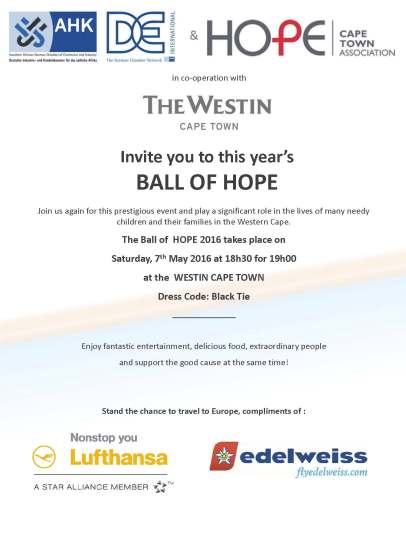
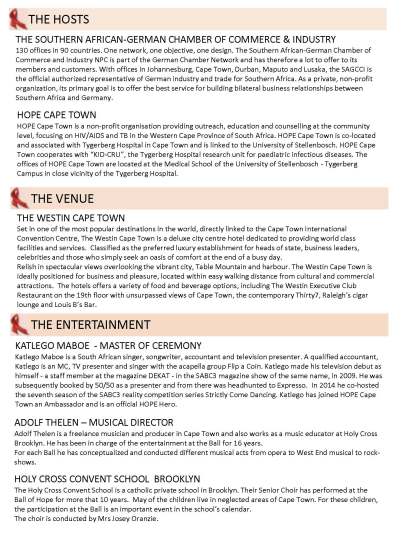
Ball of HOPE 2016 in Cape Town

Ball of HOPE 2016 invite and intro_Page_1 Ball of HOPE 2016 invite and intro_Page_2 Ball of HOPE 2016 invite and intro_Page_3 Ball of Hope BOOKING FORM 2016

Filed under: Africa, Catholic Church, chaplain, General, HIV and AIDS, HOPE Cape Town Association, HOPE Cape Town Association & Trust, HOPE Cape Town Association & Trust, HOPE Cape Town Trust, SA-German Chamber of Commerce & Industry, South Africa, Uncategorized, , , , , , , , , , , , , , , , , , , , , , , , ,

Moral responsibilities to disclose your HIV status?

Moral responsibilities to disclose your HIV status to partners aren’t so clear-cut

By Bridget Haire

Bridget Haire is a lecturer in ethics, HIV prevention at UNSW Australia.
This article was originally published on The Conversation. Read the original article.

Sexual ethics is an area prone to strongly felt moral intuitions. We saw this play out in the good, bad and sometimes ugly commentary following Charlie Sheen’s public disclosure of his HIV status. But just how much disclosure is it reasonable to expect from a sex partner, particularly if that relationship isn’t a serious and committed one?
Common morality
There is a “common morality” precept that for sex to be truly consensual, sexual partners need to disclose certain facts to their intended partner. This includes information about sexually transmissible infections, and whether the person is in a committed (supposedly) exclusive relationship such as a marriage. Identity is also relevant. It’s generally considered wrong (and often a crime) to have sexual relations with someone by means of deception such as impersonation.
Withholding material facts or deceiving a sexual partner deprives a partner of making an informed choice about whether or not to engage in sex, given the particular social and health contexts that apply. If consent to sex was dependent on an intentional deception, it was coerced rather than freely given. This “common morality” precept is also upheld from a sexual rights perspective. This decrees that every person has the right to freedom and to protection from harm, such as those harms that accrue from coerced sex.
But there are exceptions
These principles appear fairly straightforward but can become vexed when there is risk for the person disclosing, or it’s unclear whether the facts themselves require disclosure. Consider instances where transgendered people may seek to “pass” as their non-birth gender to a sexual partner. Under the sexual rights framework, all people have a right to non-discrimination and to enjoy fundamental rights and freedoms on an equal basis to others. These fundamental freedoms include the right to sexual pleasure. If the intended sexual partner of a trans person is not accepting of transgender concepts and is entrenched in gender binaries, he or she may react to disclosure by rejection or even violence. Arguably then, it may be reasonable not to disclose transgender status given that it could involve serious risk, foreclose the possibility of sexual pleasure and expose the disclosing person to discriminatory hostility.
From the condom code to negotiated safety
When HIV first erupted in the 1980s, gay communities emphasised condoms as a universal precaution, rather than relying on the disclosure of HIV status, which was not always known.
The condom code of the 1980s was also a community-building strategy that recognised the importance of sex for gay men who had fought to have laws criminalising gay sex removed. The stigma and discrimination that had been associated with homosexuality transformed into gay liberation and pride. The condom code emphasised mutual protection rather than a division along the lines of HIV status. This avoided some of the perils of HIV stigma at a time when connection and support were of critical importance in order to care for the sick. As the epidemic matured and treatment options developed from marginally effective drugs with difficult side effects to the highly effective and well-tolerated combination therapies used today, prevention responses also evolved. From the early 1990s, gay men in couples began to make strategic use of HIV testing to determine whether or not they needed to use condoms with each other. This strategy, dubbed “negotiated safety”, was one of several ways to reduce HIV risk that involved testing. Now, HIV treatment can reduce one’s viral load to undetectable levels and reduce HIV transmission to partners. This has raised questions about whether people with undetectable viral loads can consider themselves uninfectious, and whether they are legally or morally compelled to disclose their status to partners. Interestingly, some public health laws such as the New South Wales Public Health Act require disclosure. But taking “reasonable precautions” against transmitting the infection is cited as a defence. Whether or not such “precautions” may include maintaining an undetectable viral load, as distinct from using a condom, has not been tested.
Disclosing HIV status
At the moral level, does a person with HIV have a duty to disclose her or his status to a sex partner? That depends. While sex is a physically intimate act, sexual relationships have different levels of depth and intensity, ranging from the most seriously committed to the casual and transient. Duties to sexual partners must therefore sit on a gradient. Within the most trusting and committed relationships, non-disclosure of a serious infection such as HIV would undermine the intimacy of the partnership. In casual sex situations, however, HIV disclosure may not be morally required (though in many Australian states it remains legally required), so long as some form of safe sex is practised. Some communities have long recognised that using a condom could discharge the responsibility to disclose. Arguably, maintaining an undetectable viral load could also be seen as adequate, particularly if combined with further risk-reduction measures such as strategic positioning (adopting the receptive role during unprotected sex). With the many and varied relationships that fall somewhere between the two poles, degrees of trust need to be negotiated, and not assumed. All people have duties to their sexual partners regardless of their HIV status and all people have a responsibility to be moral actors in a sexual community. Stigmatising and rejecting sexual partners on the basis of an HIV status needs to be recognised as a moral wrong that works against creating a culture where HIV can be discussed freely and without fear. The response to Charlie Sheen’s announcement of his HIV status demonstrates we have a long way to go before banishing the discriminatory and offensive reactions to HIV-positive people. It’s time to recognise the role that every sexual actor plays in creating a culture where sex is safe for all

Filed under: General, HIV and AIDS, HIV Prevention, HIV Treatment, Medical and Research, Reflection, Religion and Ethics, Society and living environment, , , , , , , , , , , , , , , , , , , , , ,

Advent – Year of Mercy begins in Africa

Year of Mercy

The year of Mercy – beginning in Africa – holds also a message of hope for those thorn apart by stigma, sickness, hopelessness – it is a great entry for the day, we celebrate on the 1st of December: World Aids Day. A celebration that we are all called to turn stigma into blessings, like we are called to turn hate into love and war into peace. It is at the end all interconnected and it appeals not only to Christian but to all people of goodwill.

Sunday 29.11.2015 – Bangui CAR
The Extraordinary Jubilee of Mercy has begun. It began more than a week ahead of the opening of the Holy Door of St. Peter’s Basilica. Pope Francis opened the wood and glass door of Bangui Cathedral in CAR just a short while ago. Before opening it, he spontaneously explained the significance of his gesture.
“Today Bangui is the spiritual capital of the world,” the Pope said. “The Holy Year of Mercy begins earlier in this land that has suffered for many years as a result of war, hatred, misunderstanding and a lack of peace.”
“This land of suffering is a reflection of all countries around the world that have experienced the cross of war. Bangui is the spiritual capital of prayer for God’s mercy. Let us all ask for peace, mercy, reconciliation, forgiveness and love. Let us ask for peace and reconciliation for Bangui, for the Central African Republic and for all countries afflicted by war!”
The Pope said we need to “free ourselves of divisive notions of family and blood in order to build a Church which is God’s family, open to everyone, concerned for those most in need. This presupposes closeness to our brothers and sisters; it implies a spirit of communion. It is not primarily a question of financial means; it is enough just to share in the life of God’s people.” He reminded the faithful that one of the most important duties of a Christian is “the love of our enemies, which protects us from the temptation to seek revenge and from the spiral of endless retaliation. Jesus placed special emphasis on this aspect of the Christian testimony. Those who evangelize must therefore be first and foremost practitioners of forgiveness, specialists in reconciliation, experts in mercy.”

“In every place, even and especially in those places where violence, hatred, injustice and persecution hold sway, Christians are called to give witness to this God who is love. … Thus what the pagans said of the early Christians will always remain before us like a beacon: ‘See how they love one another, how they truly love one another’.”

“God is stronger than all else…” … “This conviction gives to the believer serenity, courage and the strength to persevere in good amid the greatest hardships. Even when the powers of Hell are unleashed, Christians must rise to the summons, their heads held high, and be ready to brave blows in this battle over which God will have the last word. And that word will be love!”

“To all those who make unjust use of the weapons of this world, I make this appeal: lay down these instruments of death! Arm yourselves instead with righteousness, with love and mercy, the authentic guarantors of peace.”


Filed under: Africa, Catholic Church, General, HIV and AIDS, Religion and Ethics, Society and living environment, , , , , , , , , , , ,

Silence or the aftermath of a living legend

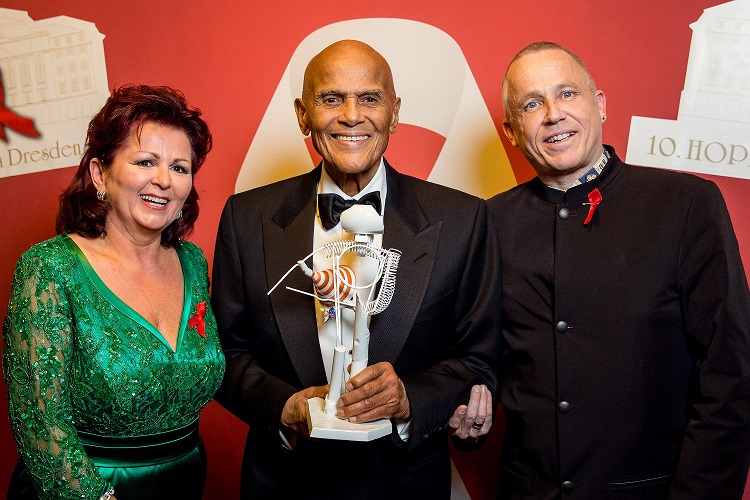
Done – the 10th HOPE Gala in Dresden is part of history and most guests from far have left the city again – others have returned to their daily struggle in so many different ways. There is always that feeling of emptiness after such a big event – memories are formed, thoughts are structured and emails and pictures and newspaper clips remind you on what happened not so long ago.
Silence – I can hear the silence breaking through after days of meetings, encounters, celebrations, dinners, touching moments – and one is again alone with oneself.
But one memory is sticking in my head – another encounter with the living legend Harry Belafonte, “Mr B” as his daughter Gina called him. Charity dinner and HOPE award – and some moments of having a conversation with him. Movie clips recall the first black entertainer appearing on US TV together with a white performer. A friend of Martin Luther King, part of the black movement and the march onto Washington; his fight for civil rights in the USA, his travels and advocacy for Africa and especially South Africa and his friendship with Nelson Mandela – all coming to life in a 10 minute trailer during the charity dinner. But one sentence is still stuck in my mind: “I have never thought that I will campaign and fight for the same things 50 years later again”, he recalls while attending to racial violence in the suburbs of US American cities.
With 88 years, it seems the conclusion is that the fight never stops and that one can do so little only to be change the world or parts of it. But at the same time he is such an inspiration and encouragement while speaking and sharply analyzing the situations of todays world and confirming that he believes in the goodness of humanity.
And he is charming – telling me that “Fr Stefan and Pope Francis” are giving him hope for the Catholic Church and reconciles him a bit as a born Catholic with his church is obviously music in the ears of a priest working in South Africa . But it is also more than flattery after his also long personal struggle with the Catholic Church. And it does not end there: He has the ability to encourage and touch the lives of people instant and with a smile and an aura I have only so far experienced when I met Nelson Mandela. One can feel the struggle, the wisdom and the maturity, but also the goodness of a person without making him an instant saint – he remains human and looking at eye level.Silence – and somehow lots of faces are appearing in my mind – all those people I met during the events in Dresden, all the people who simply gave up time and / or money to come to attend, to support, to give, to share, to participate, to contribute and to make sure that Dresden is heard in this world as a city with heart and soul caring for those infected and affected by HIV and Aids far away in South Africa. For me that is another magic to be touched by the friendliness and commitment of thousands of people in the last 10 years being faithful to one cause – not letting us down but continuing to believe that sharing is making the world a better place. Ubuntu in the best sense of the word.

Silence outside, but inside there are volcanic eruptions of thoughts, of gratefulness, of yearning for a better world, for bridging the gap; there is exhaustion and joy, but also the resolutness to stand up and walk another year in the hope of touching lives and bridging gaps to better the world by assisting those less fortune. And the hope that one day this seemingly endless struggle succeed and the world is a better place for all. Remember these words from the son “We are the world..”? A song Mr B organised to make us all aware of our responsiblity – until today.

I want to conclude this silent reflection with a thanks to Saxonia Systems, Viola and Hermjo Klein, ParX and Michaela Gornickel and her team and all involved in the 10th HOPE Gala in Dresden. You are all in my heart which is grateful forever.Foto Michael Schmidt vl Viola Klein Harry Belafonte Stefan Hippler001

Filed under: Catholic Church, General, HIV and AIDS, HOPE Cape Town Association & Trust, HOPE Cape Town Trust, HOPE Gala Dresden, Reflection, , , , , , ,

Blog Categories

Follow God, AIDS, Africa & HOPE on WordPress.com

You can share this blog in many ways..

Bookmark and Share

Enter your email address to follow this blog and receive notifications of new posts by email.

Join 2,711 other subscribers

Translation – Deutsch? Française? Espanol? …

The translation button is located on each single blog page, Copy the text, click the button and paste it for instant translation:
Website Translation Widget

or for the translation of the front page:

* Click for Translation

Copyright

© Rev Fr Stefan Hippler and HIV, AIDS and HOPE.
Unauthorized use and/or duplication of this material without express and written permission from this blog’s author and/or owner is strictly prohibited. Excerpts and links may be used, provided that full and clear credit is given to Rev Fr Stefan Hippler and HIV, AIDS and HOPE with appropriate and specific direction to the original content.

This not withstanding the following applies:
Creative Commons License
This work is licensed under a Creative Commons Attribution-ShareAlike 3.0 Unported License.