God, AIDS, Africa & HOPE

Reflections / Gedanken

Visit by German Minister Annette Schavan to HOPE Cape Town

At the containerTowards the end of the German-South African Year of Science, the then German Minister of Education and Research, Dr. Annette Schavan, and her delegation visited HOPE Cape Town on February 7, 2013. The German visitors were hosted at the Blikkiesdorp informal settlement where HOPE Cape Town runs an outreach programme that supports HIV-infected children and their families. During this visit the German delegation was also informed about the collaboration between the Pharmacology and Virology Divisions of the University of Stellenbosch and HOPE Cape Town.

 Just before 4 p.m., Rev. Fr. Stefan Hippler, employees of HOPE Cape Town and Professors Bernd Rosenkranz and Wolfgang Preiser from the University of Stellenbosch welcomed Dr Schavan and her delegation of about 30 people from the German parliament, academic and other institutions to Blikkiesdorp. Previously, the minister had attended meetings with local and international enterprises and organisations in South Africa in order to consolidate the scientific cooperation between both countries.

Prof Dr Bernd Rosenkranz, Head of the Division of Pharmacology, and his colleague Prof Dr Wolfgang Preiser, Head of the Division of Medical Virology, both also HOPE Cape Town board members, shared their experiences of being part of a joint German-South African research project on infectious diseases with the group. One project that was presented described how German students had the opportunity to familiarize themselves with diseases common in South African that are rare in Germany. In return, the joint research project allowed South Africans to develop new forms of treatment that had been tested in Germany before.

Rev. Fr. Hippler introduced the non-profit-organisation HOPE Cape Town to the audience. He highlighted the importance of the world-wide network of the charity and emphasised the significant contribution that the cooperation between international medical research initiatives and local communities brings about. Moreover, the catholic priest underlined how the work of HOPE Cape Town’s 30 employees at the Ithemba ward at Tygerberg Hospital and in 20 primary health care facilities in various informal settlements contributes to the fight against the HI virus.

The visibly interested minister and her delegation from Germany were invited to walk through Blikkiesdorp and meet its inhabitants whilst Rev. Fr. Hippler and the HOPE Cape Town community health workers explained to the visitors under which difficult circumstances people live there. Furthermore, the delegation was informed about the severe social problems such as unemployment and domestic violence that mark people’s  daily existence. Through visiting HOPE Cape Town’s project in Blikkiesdorp the foreign visitors were given an authentic albeit a little uncomfortable experience of the challenges that people living in informal settlements face on a daily basis. The German delegates enjoyed the hands-on experience as a welcome alternative to the usual power-point presentations that they have to sit through on such visits.

Minister Visit shavan03


Filed under: HOPE Cape Town Association, HOPE Cape Town Association & Trust, Medical and Research, Networking, , , , , , , , , , , , , , , , , , ,

When wild garlic makes you pregnant

Pius Fasinu(left), Prof Bernd Rosenkranz (right) and those involved in the research

Pius Fasinu(left), Prof Bernd Rosenkranz (right) and those involved in the research

HOPE Cape Town is not only working on grass root level but also involved in academic research; a holistic view of HIV and AIDS has been at the core of the work of  HOPE Cape Town since the beginning. With the permission of the author we publish this article explaining an exciting research on muti – the medicine of sangomas in South Africa through the PhD student Pius Fasinu:

When wild garlic makes you pregnant

Pius Fasinu

People who use traditional remedies together with conventional medicines may want to rethink their strategy, because the combination of these substances might be doing them more harm than good.

Researchers have found that certain African medicinal herbs, including wild garlic and the African potato, could interfere with how conventional drugs work in the body. The herbs included in the study are traditionally used to treat diseases such as fever, pain, diarrhea, asthma, cold, cough, infections, hypertension, depression and ailments related to HIV and Aids.

Preliminary results of the study being conducted by the Division of Pharmacology at Stellenbosch University (SU) have shown that the herbs can quicken or delay the elimination of conventional drugs from the body. “This adds to the risk of treatment failure or toxicity,” says Pius Fasinu, a doctoral student in pharmacology.

“Patients should tell their doctors if they are taking any herbal medicine, or at best avoid taking the herbs and conventional medicines together,” is Fasinu’s advice based on the findings.

Traditional medicine and especially the use of medicinal herbs are popular in South Africa. “While the use of medicinal herbs predates the emergence of HIV and Aids, a number of indigenous herbs are widely consumed as immune boosters and to manage the symptoms of this disease,” explains Fasinu, who is completing his research under supervision of Prof. Bernd Rosenkranz and Prof. Patrick Bouic of the SU Division of Pharmacology in the Faculty of Medicine and Health Sciences.

The high disease burden and the strong attachment of traditional medical practices to culture and tradition have prompted various African governments to start integrating traditional medicine into the mainstream healthcare.

”Nearly two in every three people who live with HIV and Aids combine their antiretroviral drugs with medicinal herbal products,” adds the doctoral student who is doing an in vitro assessment of selected traditional medications used in South Africa and their pharmacokinetic drug interaction potential.

For purposes of his study, Fasinu consulted traditional healers and used available literature to identify and source the most popular herbal remedies used by people who also rely on conventional healthcare.

African potato (Hypoxis hemerocallidea), fat hen (Chenopodium album), devil’s thorn (Emex australis), cancer bush (Sutherlandia frutescens), sweet thorn (Acacia karroo) and wild garlic (Tulbaghia violacea) were included in the study, and were shown to interfere with the functioning of conventional drugs in the body.

The herbs were not tested for their therapeutic benefit or for their potential toxicity when they are taken on their own. Rather, herb extracts were tested to see what their effect was on the enzymes in the body that are responsible for metabolising and eliminating conventional drugs.

Fasinu’s tests showed that the herbal extracts inhibited the majority of these enzymes. “This suggests that conventional drugs taken with some traditional herbs may accumulate in the body because of the enzyme inhibition,” Fasinu believes. “This leads to toxicity.”

In some cases, herbal derivatives also had the opposite effect, in that it induced the production of more enzymes and therefore sped up the metabolism of the drugs. This could lead to the failure of conventional drug treatment because it is cleared from the body far too quickly to be beneficial. Samples from human livers that contain the active enzymes were used to assess the impact of herbal extracts on drug clearance. It provided the closest scenario to herb-drug combination in humans.

“Hypertension may persist if herbs are taken together with anti-hypertensive drugs, and pregnancy may occur when they are taken with contraceptive pills,” he cites some of the inadvertent consequences of using traditional and conventional treatments together.

“Despite the popularity among South Africans to use herbs and conventional medicine side by side, there is little information available on how safe this practice is,” a concerned Fasinu says. “Considering the potential consequences, it is best to exercise caution.”

 “Pius Fasinu, with the support of HOPE Cape Town”, phasynou@gmail.com

Filed under: HIV Treatment, HOPE Cape Town Association, HOPE Cape Town Association & Trust, HOPE Cape Town Trust, Medical and Research, Society and living environment, Uncategorized, , , , , , , , , , , , , , , , , , , , , , , ,

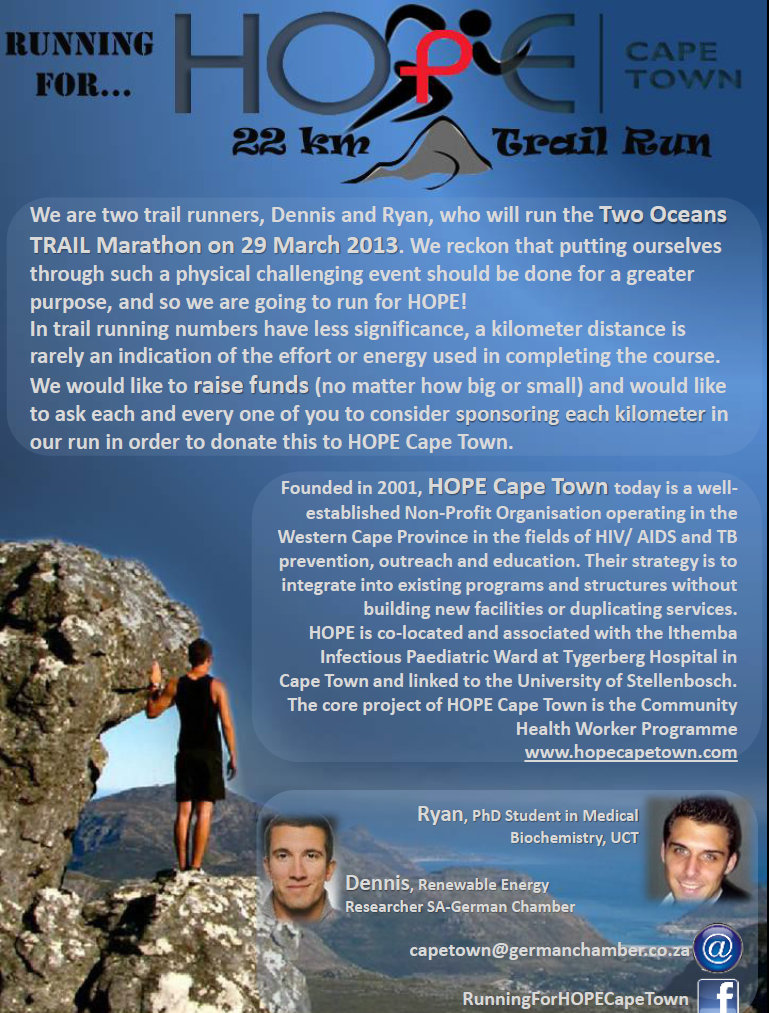
Another way of supporting HOPE Cape Town

RunforHOPECapeTown

more info: admin@hopecapetown.com

Filed under: HOPE Cape Town Association, HOPE Cape Town Association & Trust, HOPE Cape Town Trust, SA-German Chamber of Commerce & Industry, , , , , , , , , ,

Compliments of the Season

It’s never too early: I am taking this opportunity to thank everyone who made 2012 a fabulous year…
Hoping 2013 will be a blessed and best one for all of us – Somebody shout Amen!

For all those I’ve made promises to and never kept – Ek is baie jammer, it was not intentional but I will do better in 2013.

Those that I owe lunches, kisses, dates, etc. eish, I’ll do my best to fulfil.

 For those that have supported me and made me smile through all my hardships… I truly appreciate you – May God bless you!

For those I’ve disagreed with, argued with and just never got along with…… well, 2013 is another year, pasop!

Those that I’ve hurt… unintentionally/intentionally… I’ve probably apologized – “I’m Sorry” again…

For those that stuck a knife in my back… oppas, ek het ‘n gun gekry…. Nah, relax… 4giveness is the best revenge!!! 

For those that have let me down… DANKIE….’twas just another stepping stone closer to my destiny!!!    

To all my real friends … I bought us some superglue

But all in all, you have made 2012 a great year; I wish you and your loved ones prosperity, good health, wealth, happiness, greener pastures, abundant blessings…and a  Wonderful Festive Season

May 2013 be the year you achieve wonderful things and grow in maturity and wisdom..

Blessings & Peace

 Fr Stefan

Now @ sea till mid January

Now @ sea till mid January

Filed under: Catholic Church, Center of Healing, General, HIV and AIDS, HIV Prevention, HIV Treatment, HOPE Cape Town Association, HOPE Cape Town Association & Trust, HOPE Cape Town Trust, HOPE Gala Dresden, Medical and Research, Networking, Politics and Society, Reflection, Religion and Ethics, SA-German Chamber of Commerce & Industry, Society and living environment, Uncategorized, , , , , , ,

Culture and language

Township Blue

Township Blue (Photo credit: Joseph A Ferris III)

Traveling through some European countries again I sometimes reflect on the distances between people’s understanding and imagination. Townships and life conditions of most South Africans are known to many in Germany only via TV, a view protected by glass and the possibility to switch it off when it comes to close. How does one bring the real colors, the smell, the atmosphere from one continent to the other?

Also the question of realities and how I name them is different and having the same vocabulary does not mean to understand each other. This is true when talking about people from different life environments, but even within my own circles I often experience that words can have so many different meanings and create so many different associations. What very often irritates me is that words are connected with judgement, with “good or bad” feelings, with “white or black” . The older I get the more I get irritated when descriptions are perceived as judgements and how often people take things much more personal than they are meant to be.

I guess, this all is important to reflect when traveling the world to bring people together and let them join hands, who are far away and maybe even never meet, but hear about each other. But this also important to reflect when working in international teams where people from different cultures and languages are working together. Also HOPE Cape Town has this kind of challenges, bringing together different South African cultures and adding the European spice. Quite a mixture, but I believe in diversity and I am sure that this challenge is also an asset because it forces us again and again to listen to each other and to learn from each other. A lifelong and never-ending learning curve – and at the same time a motor for development into the future.

Filed under: General, HOPE Cape Town Association, HOPE Cape Town Association & Trust, HOPE Cape Town Trust, Networking, Politics and Society, Reflection, Society and living environment, , , , , , , , , , , , , , ,

Blog Categories

Follow God, AIDS, Africa & HOPE on WordPress.com

You can share this blog in many ways..

Bookmark and Share

Enter your email address to follow this blog and receive notifications of new posts by email.

Join 2,711 other subscribers

Translation – Deutsch? Française? Espanol? …

The translation button is located on each single blog page, Copy the text, click the button and paste it for instant translation:
Website Translation Widget

or for the translation of the front page:

* Click for Translation

Copyright

© Rev Fr Stefan Hippler and HIV, AIDS and HOPE.
Unauthorized use and/or duplication of this material without express and written permission from this blog’s author and/or owner is strictly prohibited. Excerpts and links may be used, provided that full and clear credit is given to Rev Fr Stefan Hippler and HIV, AIDS and HOPE with appropriate and specific direction to the original content.

This not withstanding the following applies:
Creative Commons License
This work is licensed under a Creative Commons Attribution-ShareAlike 3.0 Unported License.