

A reflection by Henning Mankell
It is an autumn night when I suddenly wake up. As my eyes open in the pre-dawn darkness, I wonder what it was that seized me from my sleep. Before too long I start to brood. I already know what troubles me – the sensation of an imminent threat. It forces me into a state of full consciousness. It’s nothing like the disjointed abstractions of a dream. I consciously experience the menace which roused me. I am on a battlefield, but where are my weapons? The enemy is invisible and I have no artillery. The battlefield seems to widen. I can see no boundaries. But to speak of a “threat” is not quite accurate. What I mean to say is that I wake up with a sense of dread.
I will happily admit that there are times when I am filled with fear. People who claim that they have no fear are either cynical or they lie. I’m talking about Aids. I awake with a fear that people in the Western world don’t understand the extent of the epidemic which is racing across the globe.
When we speak or think about dread diseases, we tend to do so in terms of “us’ and “them”. But with Aids there are no such categories. Such categories would distort reality and our acuity. There is no “them”, only “us”, even if we in the West are fortunate enough to still be spared from the proliferation of the disease. In Western Europe, the numbers of infected people have not yet skyrocketed. It already has in some Eastern European enclaves, but not yet in the West. Not yet. This is the world today, in its stark reality. We in the West stand at the front of the queue when it comes to access to the latest antiretroviral medications which will allow us, in conjunction with our better living conditions, to live longer, even if we do have the HI virus.
I lie in the darkness and think about how we might come up with a new terminology to classify the world. We used to speak about rich and poor, of developed and underdeveloped. Now we can speak about the chronically ill and the mortally ill. This is not, of course, an absolute truth. Yet, for the majority of HIV-infected people in the rich pockets of the world, Aids can be seen as a more or less controllable chronic illness. In poor countries, HIV-infection can be equal to a death penalty. Only a few are reprieved or have their sentence commuted to a chronic life term, as is the privilege of those who by the roll of the dice were born in the wealthy parts of the world.
And that’s what the world looks like that autumn night. My eyes stare into the darkness and I reminisce. In 1985 I watched a young man disembark from a bus. It was in Kabompo, right on top of the north-western corner of Zambia, on the Angolan border. The young man was emaciated, he had sores in his face, and after staggering a few paces he collapsed. Relatives who had come to fetch him carried him to the hospital where two Dutch doctors fruitlessly tried to help him. A few days later the young man was dead. He was the first person I saw dying of Aids, but certainly not the last. This was more than two decades ago, at the beginning of what would become a colossal epidemic.
A good friend of mine, a fervently enthusiastic Swedish Aids doctor, travelled the world even in high age to advocate for those with Aids and to endeavour that as few people as possible would be infected. He told me about a dinner conversation he had with his wife in the autumn of 1981. She had just returned from a conference on sexually transmitted diseases, hosted by the US Centre for Disease Control in Atlanta. During the breaks, over coffee and in corridors, she had learnt about peculiar cases of a peculiar illness in the United States. It was the first time my friend had heard about the disease which later came to be called Aids. These first cases, which gradually attracted the attention of scientists, doctors and disease control offices, mostly involved homosexual men. Initially there was a lot of uncertainty about what was happening. Very few could imagine that this was the beginning of one of the most terrible epidemics in human history – not even after the virus was identified and it had become evident that this was an extremely dangerous disease which did not only affect homosexuals but actually endangered everybody with an active sex-life, and which could even be transmitted from a nursing mother to her child.
So, what was the world like back then, in 1981? More than a decade previously we had put a man on the moon and returned him alive. We were at the nascent stage of an electronic revolution which would change the world perhaps even more dramatically than the industrial revolution, which had eliminated agrarian and feudal systems. Soon, perhaps, even the mystery of cancer might be solved. Then there were scientists who predicted a new biological revolution, propelled by a broadening understanding of the structure of the human gene. Shouldn’t we be in a position to deal with that new type of virus which had appeared on the human stage? It would take a while, however, before the realisation set in that this virus was unlike any other ever known. Until then there was a general sense of more or less palpable hubris. Arrogance over humility.
Now we know what we didn’t know then: millions are dead, millions are ill, millions are at risk of infection. We have come to understand that the HI virus, in its many forms, represents a colossal challenge to all of humanity. Unlike other viruses which have infringed on the human race since it emerged from the mists of pre-history, this virus has colonised us forever.
That was probably the most dramatic conclusion: we must accept that we might never eradicate this virus. It has come to stay. If we cannot eradicate it, then we must learn to live with it, to rein it in, to control all illnesses that might let loose the effects of the virus. It is true that we humans never give up and always maintain hope, but we must reasonably presume that neither a cure nor a vaccine is imminent. Of course there a scientists and institutions who with all their force seek ways to find a cure. In truth, however, there is no compelling reason to believe that a solution is in sight. We must learn to live with Aids. We must understand that we are not dealing with impending challenges, but with those that are already consuming us.
These are the tracks of my thoughts as I stir in the darkness that autumn night. A quarter of a century after the discovery of the virus – which, of courses existed long before its decisive transmission from one human being to another – we know much more about it than we did then.
At the same time, we must ask where mistakes have been made. Why did we not react sooner to all these signs which were evident ten, even fifteen years ago, to mobilise all our resources to fight the epidemic before it slips us by and really gets out of control. Why did we prevaricate for so long? Why were the countermeasures introduced so hesitantly, so badly organised, so aimlessly? Why did so many political leaders around the world seem paralysed in the face of what was happening to their people? Why did some of them deny that this disease even existed? Why was so much time wasted fishing, with misguided zeal, in the murky waters of conspiracy theories, such as those claiming that the virus was developed in “hostile” labatories to exterminate the world’s “surplus” poor? In short, why didn’t we do what we should have done ten, fifteen years ago?
There are many explanations. It is a fact that a few leading African politicians stubbornly denied the disease. Their most prominent and appalling representative was South Africa’s President Thabo Mbeki. But it wasn’t just him. Other African leaders also remained idle. Eight or so years ago, a survey in Mozambique found that a large proportion of the population does not believe in a disease such as Aids.
When the history of Aids is written, it will record that the politics of obfuscation were practised in many parts of the world, and not least in Africa. There were too many other problems that demanded precedence. HIV infection creeps up quietly, manifesting itself in people only when it already has turned into Aids and all hope is lost. It was easy to marginalize it, to pretend it didn’t exist, at least for some time. Those in the know – the politicians, the intellectuals – acted against the evidence before them. They were silent, or if they did speak out, then too vaguely and faintly.
More far-reaching and criminal was that we, including the enlightened intellectuals, did so utterly little to foil this schism between “us” and “them” which entrenched itself very soon after the disease was discovered. We failed, like so often before. We saw the warning signs of a looming disaster, but this prompted silence and evasion. The mass media wrote and reported, but there was no genuine endeavour to install Aids into the public consciousness and to excite civic resistance. After all, it wasn’t “us” who were affected by this great catastrophe, but “them”, others.
Kofi Annan, the former secretary-general of the United Nations, once asked why unlimited resources were made available when it came to fighting terrorism in the world, but when it came to the fight against a lethal virus which doesn’t even have a political programme, measures were so limited and belated. Of course we won’t ever have the capacity to make available enough resources to fight the Aids epidemic. Whatever we do, it will always be too little, too late. But that must not get in our way of doing significantly more and significantly better than before.
The fight against Aids is humanism’s ultimate battle. To begin with, we must observe the positive examples which do exist, in spite of it all. A demonstrable transformation took place in Uganda after the country’s political leadership, right up to the presidency, mobilised all its might to check the spread of HIV. Since then, new infections in the central African country have receded to some extent. The difference is not all that great, but it is still significant because it reveals what is possible when the leaders of a country are mindful of their responsibilities.
One wonders what might have been had Nelson Mandela been ten years younger and had remained South Africa’s president for longer. We all know about his intensive engagement in the fight against Aids. How many fewer people in South Africa might have been infected if support and awareness programmes had been instigate under his guidance?
Where are we now? Some 25 million people have already died of Aids-related causes, with another 42 million infected. There will be an estimated five million new infections every year, and three million dead. The epidemic has not yet peaked – that might still take decades. We can expect at least 50 million new infections in the coming decade.
It is difficult to propose with empirical clarity what necessary measures must be taken. In a way, everything is of the same importance in the fight against Aids. Guaranteeing safe and abundant access to condoms is of equal value as it is to ensure that children everywhere have the opportunity to master their language and to become literate, so that they can make use of the relevant information. But perhaps there is one measure which is more important and more decisive than any other: to improve the situation of women in poor countries. Women whose lives consist of hard work on meagre soil, and equally hard work of keeping their families together. A woman in such a situation simply cannot demand that her husband use a condom or be faithful. Modifying the social role of such women and the extent of influence in decision-making they have will be crucial to the way in which the disease can be controlled.
A necessary precondition for this is that the efforts to narrow the gap between rich and poor countries are not only sustained, but also intensified. There is no way of controlling the Aids plague if the absurd global economic discrepancies persist. The path towards greater influence and independence for women can follow only along the objectives of economic growth, economic justice, and economic emancipation.
And so I am lying in the dark as I cogitated on these observations. Rousseau said that man is formed by reason but guided by emotion. Both emotion and reason are required to establish a worldwide solidarity movement against the devastating consequences of the Aids epidemic, something we are waiting for so impatiently. We may start thinking about being able to beat this disease, as we did previous lethal illnesses, only once fundamental positions change, particularly the attitude of men towards women, and if concurrently the topic of Aids makes it to the top of the agenda in the word’s centres of power.
We must invest our hopes in the youth, that it may not be content with current measures, but demand and launch a wholly different effort in the fight against Aids. It must not be acceptable that to sleep with somebody also is a death threat. At the same time it must be made clear that to recklessly oblige one’s egotistic sexual gratification is entirely negligent towards another person.
Much time has been lost already. But once we understand that the HI-virus has come to stay indefinitely we may be able to raise the level of our resistance. The poor woman south of the Sahara who today dies of Aids is, in this view, my sister, my daughter or my mother. The faces I see in the dark remind me of a simple truth: that the human being, and only the human being, is responsible for the future of humanity. And, as I have written so many times before: it’s not yet too late. In spite of it all.
Translation from:
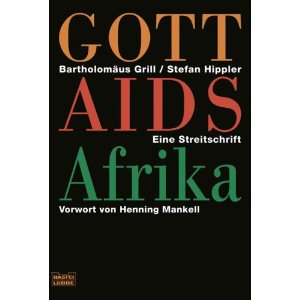
Gott – Aids – Afrika
Hardcover: 207 pages – Publisher: Kiepenheuer & Witsch GmbH (August 31, 2007)
Language: German – ISBN-10: 3462039253 – ISBN-13: 978-3462039252
Gott – Aids – Afrika
Paperback – Bastei – Luebbe –
Language: German – ISBN-10: 3404606159 – ISBN-13: 978-3404606153
Filed under: General, HIV and AIDS, HIV Prevention, HIV Treatment, HOPE Cape Town Association & Trust, HOPE Cape Town Trust, Medical and Research, Networking, Politics and Society, Reflection, Aids, book, cape town, Church Matters, gott-aids-afrika, hiv, HOPE Cape Town Association & Trust, HOPE Cape Town Trust, people living with the virus, south africa, stefan hippler, theology


 God, AIDS, Africa & HOPE